Weevil News
|
No. 29
|
8
pp. |
08th
September 2005 |
ISSN 1615-3472
|
|
|
Bialooki, P. (2005):
On the distribution of some
interesting weevils species (Coleoptera: Apionidae, Curculionidae) in
Poland. - Weevil News: http://www.curci.de/Inhalt.html,
No. 29: 8 pp.,
CURCULIO-Institute: Mönchengladbach. (ISSN 1615-3472). |
|||||
On
the distribution of some interesting weevil species (Coleoptera: Apionidae,
Curculionidae) in Poland
by
Piotr Bialooki, Sopot
with 19 figures
Abstract
New records of
52 rare species of Apionidae and Curculionidae, predominantly from northern
Poland are given. Most of them are recorded for the first time from particular
regions. Anthonomus germanicus Dieckm. and Acallocrates colonnellii
Bahr discovered on isolated northernmost localities of entire range of these
species. Perapion oblongum (Gyll.) and Microplontus melanostigma (Marsh.) (syn. Microplontus figuratus (Gyll.))
once recognized as rare species, are actually common in northern Poland.
Streszczenie
W pracy niniejszej podano dane o rozmieszczeniu 52 rzadkich
gatunków Apionidae i Curculionidae, głównie z północnej Polski. Większość
z nich wykazano po raz pierwszy z poszczególnych krain. Potwierdzono
stare, ogólnikowe doniesienia o występowaniu Acallocrates colonnellii
Bahr (syn. A. denticollis auct., nec Germar, 1824) w Prusach. Na
izolowanym stanowisku (Toruń), wysuniętym znacznie poza północną
granicę zasięgu, wykryto Anthonomus germanicus Dieckm. Perapion oblongum (Gall.) i Microplontus melanostigma (Marsh.) (syn. M. rugulosus auct., nec Herbst, 1795) uznawane za
gatunki rzadkie, w północnej Polsce występują dość
pospolicie.
Keywords
Faunistic records, Coleoptera, Apionidae,
Curculionidae, Poland.
All
specimens, mentioned below were collected by me (with the exception of one
specimen) and are kept in my collection. Nomenclature and definition of regions by Katalog Fauny Polski
[Burakowski, Mroczkowski, Stefańska 1992]. Unless otherwise noted in text, data on
distribution of species are based on
abovementioned work and that of Mazur [Mazur 2001]. Regions are marked with an
asterisk (*) if a particular species is recorded for the first time from there.
I would like to
thank T. Konefał (Toruń) for the specimen of Anthonomus germanicus,
Dr. W.Ejanowski (Toruń) for determination of its host plant , Dr. W.Giłka
(Gdańsk) for making photos and Dr. M.Wanat (Wrocław) for critical
review of the manuscript.
Weevils
(Curculionoidea) of Poland are generally well known. Many faunistic papers were
published in recent years and summarized in the
fundamental Katalog Fauny Polski (Catalogus Coleopterorum Poloniae)
[Burakowski et al. 1992], [Burakowski et al. 1993],
[Burakowski et al. 1995], [Burakowski et al. 1997]. However, field
studies were carried out predominantly in southern and eastern parts
of the country. In present work, I give new data on the distribution of
52 species, mainly from northern Poland.
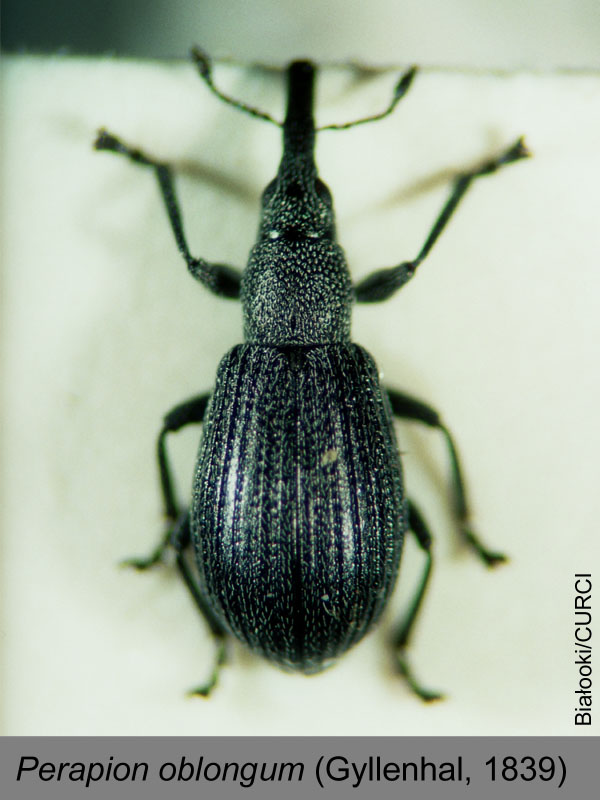
Perapion
oblongum
(Gyllenhal, 1839) [Fig. W29.1]
*Pobrzeże Bałtyku:
Sopot, 19.08.1990, 9exx.; 08.09.1990, 12exx.;
Pojezierze
Pomorskie: Kiełpino (S Kartuzy), 12.08.1995,
39exx.; Grudziądz-Mniszek, 01.08.1995, 5exx.;
Pojezierze Mazurskie: Hartowiec
(NW Działdowo), 02.08.1996, 1ex.;
Nizina Wielkopolsko-Kujawska:
Mała Nieszawka (W Toruń), 09.07.1992, 1ex.
Recently
separated from P. curtirostre (Germar, 1817), so its distribution remains
obscure. Dieckmann recognized it as a rare species connected with moist habitats
[Dieckmann 1977]. In northern Poland usually in dry places, frequently in
numerous populations.
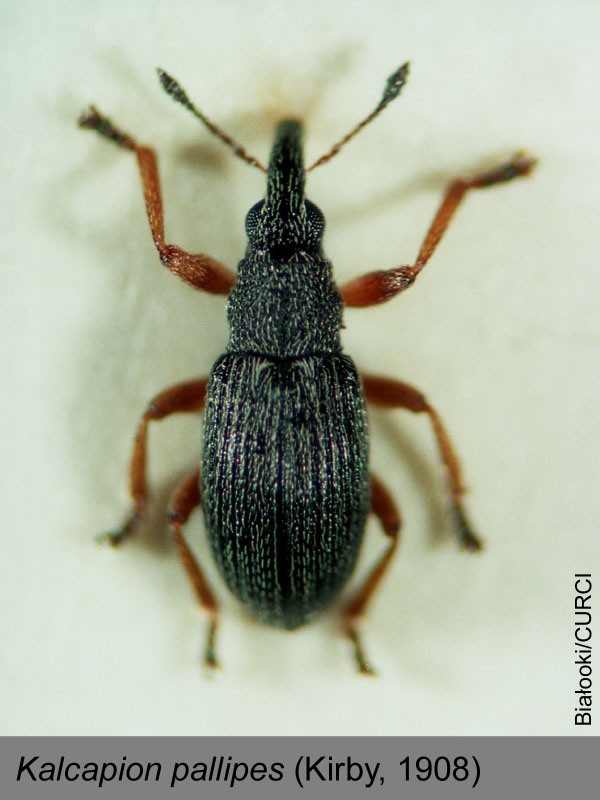
Kalcapion
pallipes
(Kirby, 1908) [Fig. W29.2]
*Pobrzeże Bałtyku:
Sopot, 17.05.1997, 1ex.;
Pojezierze Pomorskie: Babi Dół
reserve (SE Kartuzy), 24.07.1995, 3exx.; 12.08.1995, 9exx.
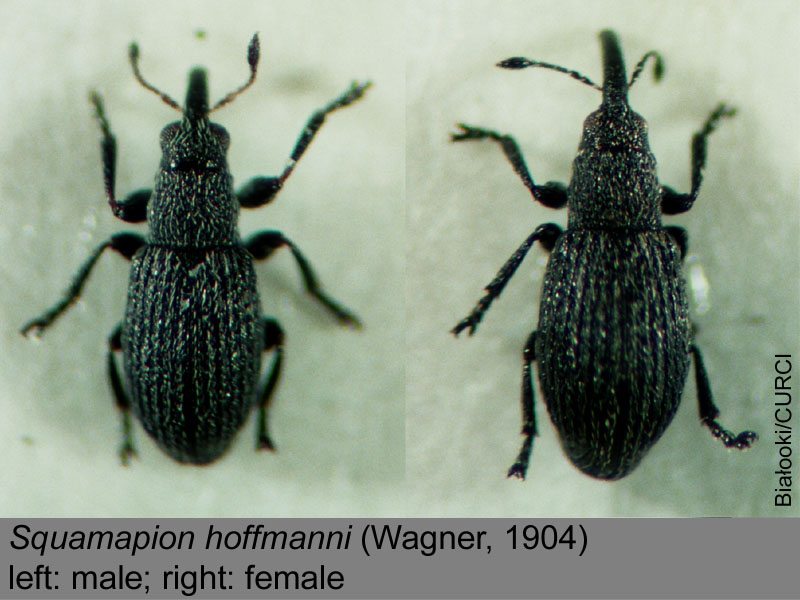
Squamapion
hoffmanni (Wagner,
1904) [Fig. W29.3]:
male-left; female-right;
Pojezierze Pomorskie: Somonino
(S Kartuzy), 16.08.1995, 6exx.;
*Pojezierze Mazurskie:
Hartowiec (NW Działdowo), 02.08.1996, 6exx.;
So far, known in
Poland from the southern part of the country
only, and in the north exclusively from lower Vistula river valley.
Ceratapion
austriacum
(Wagner, 1904)
Pojezierze Pomorskie: Swiecie,
11.07.1996, 1ex.;
Pojezierze Mazurskie: Olsztyn,
14.10.1978, 1ex.; 17.05.1979, 1ex.; Gąski (N Ełk), 01.08.1992, 2exx.;
Hartowiec (NW Działdowo), 02.08.1996, 4exx.
Only recently -
see [Mazur 2001] - recorded from a few
localities in northern Poland.
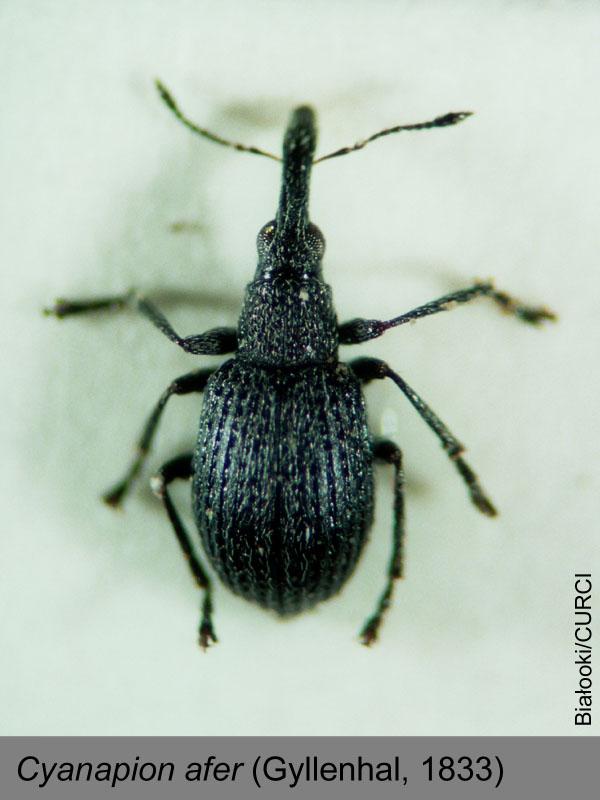
Cyanapion
afer
(Gyllenhal, 1833) [Fig. W29.4]
*Pojezierze Pomorskie: Babi Dół
reserve (SE Kartuzy), 24.07.1995, 8exx.; 12.08.1995, 6exx.
Oxystoma
ochropus (Germar, 1818)
*Pobrzeże Bałtyku:
Gdańsk-Lipce: 13.08.1995, 1ex.
Dodecastichus
inflatus (Gyllenhal,
1834)
Pobrzeże Bałtyku:
Sopot, 3-10.06.1981, 11exx.;
Pojezierze Mazurskie: Nowa Wieś
(near Toruń), 05.07.1992, 1ex.;
Mountainous species, most
probably transported by Vistula river. Possibly, century-old Wendelers record [Burakowski
et al. 1993] concerns the same locality. If so, this isolated population is very
stable.
Otiorhynchus hormuzachii
Penecke, 1935
Beskid Zachodni: Leluchów (S
Muszyna), 29.06.1995, 16exx.
Bisexual form of O.
ligustici (L.) or distinct species - the problem of parthenogenetic species
is still far from being solved. Rare form, endemic for certain areas of western
Carpathians.
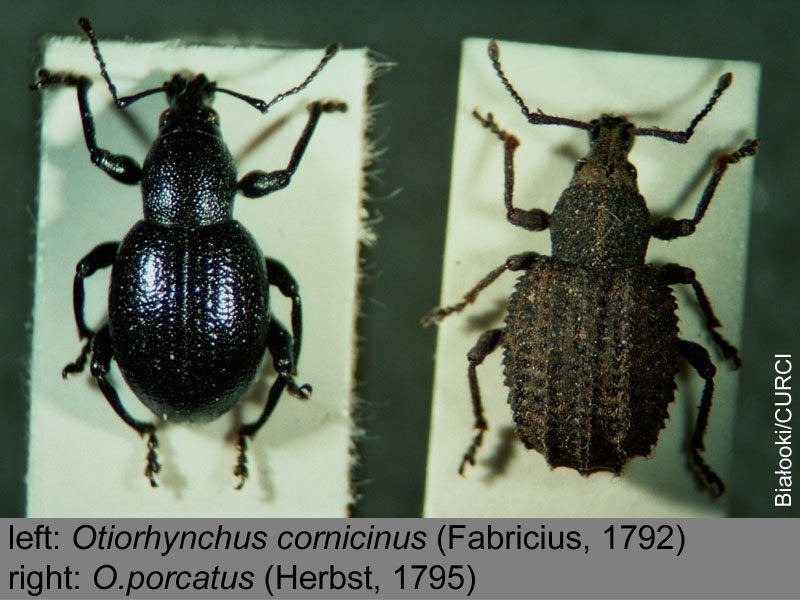
Otiorhynchus
cornicinus Stierlin, 1861
(= laevigatus (Fabricius, 1792)) [Fig.
W29.5]: left;
*Pojezierze
Pomorskie: Subkowy (S Tczew), 22.07.1996, 25exx.;
Recorded from the
south of Poland only. Probably introduced only recently, as indicated by very
limited finding area along railway. Synonymization after Colonnelli [Colonnelli
2003].
Otiorhynchus
tenebricosus (Herbst, 1874)
*Pojezierze Mazurskie: Olsztyn,
21.08.1977, 14exx.; 06.09.1977, 8exx.; 23.06.2000, 37exx.;
Surely introduced
species occurs in Olsztyn in abundance both in urban areas on cultivated plants
(Syringa vulgaris L. and to a
lesser degree on Philadelphus coronarius
L.) and in wild habitats along Łyna river, where feeding on Geum
urbanum L. was observed. It is impossible to judge, basing on
a single observation, if this plant belongs in NE Poland to the feeding
spectrum of the form lugdunensis
Boheman, 1843, strongly connected in western Europe with Syringa vulgaris
L. [Dieckmann 1980]. However, certain details of biology
of the species on this very isolated locality might be different from that
within the continuous range of the species.
Synonymization
of O. lugdunensis Boh. with O.
tenebricosus (Herbst, 1834) [Magnano 2001] is followed here tentatively,
because of morphological and especially ecological distinctness of the form lugdunensis
Boh., not exclusively in Poland.
Otiorhynchus
porcatus
(Herbst, 1795) [Fig. W29.5]:
right;
*Pojezierze
Mazurskie: Olsztyn, June to September, 1977-1979, 8exx.;
The first record
of this rare species in NE Poland. While recording this species from SE Poland
(Lublin) repeats nebulous [Cmoluch 1991]; Łomnicki
mentions Prussia [Łomnicki 1913].
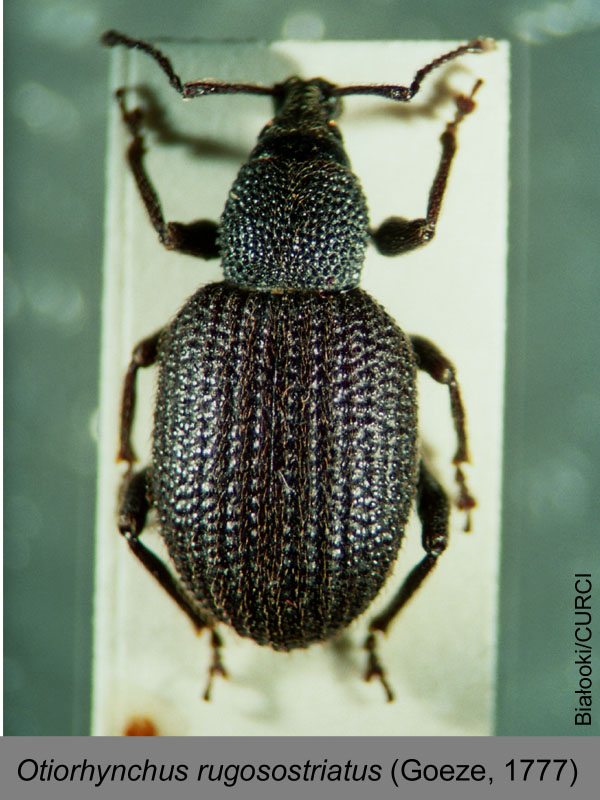
Otiorhynchus
rugosostriatus (Goeze, 1777) [Fig.
W29.6]
Pobrzeże Bałtyku:
Sopot, 29.08.1990, 3exx.; in backyard garden.
The second record
from the seashore region in Poland. For the first time given by [Kania
and Zawadzki, 1994]. Undoubtedly introduced recently.
Otiorhynchus
austriacus
(Fabricius, 1801)
Beskid Zachodni: Muszyna,
19.06.1995, 3exx.
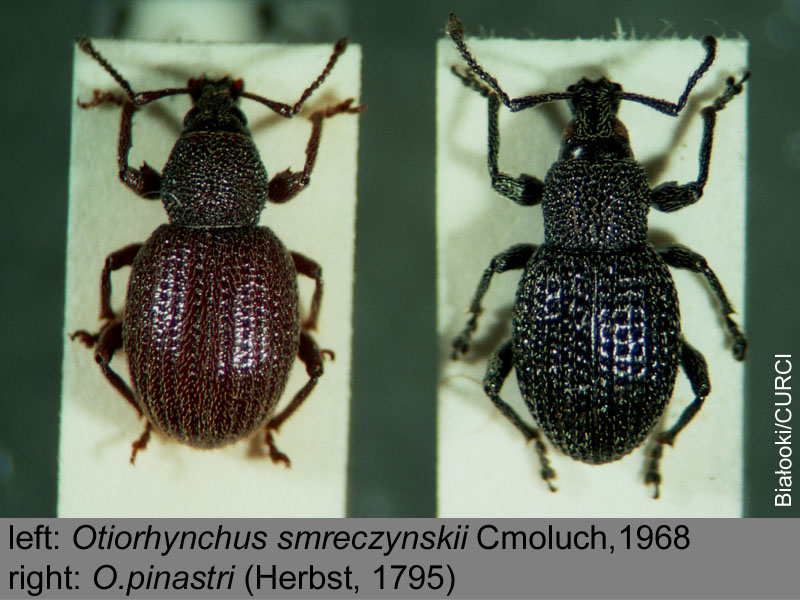
Otiorhynchus
pinastri (Herbst, 1795)
[Fig. W29.7]: right;
Beskid Wschodni: Dybawka (near
Przemyśl), 12.06.1985, 11exx.; 23.06.1998, 99exx.
Until
recently, very rare in Poland. In last several years recorded from few
localities in the vicinity of Sanok and Przemyśl
(SE Poland). Expanding species, possibly not without humans help. In 1985 the
species was collected on a very small area -
narrow strip of a few dozen meters along a road, while
already 13 years later on a vast area.
Otiorhynchus
smreczynskii Cmoluch, 1968 [Fig.
W29.7]: left;
*Pobrzeże Bałtyku:
Sopot, 22.08.1990, 3exx.; 05.06.1993, > 100exx.
Detected in one
city quarter only, predominantly on Ligustrum
L. Undoubtedly introduced recently.
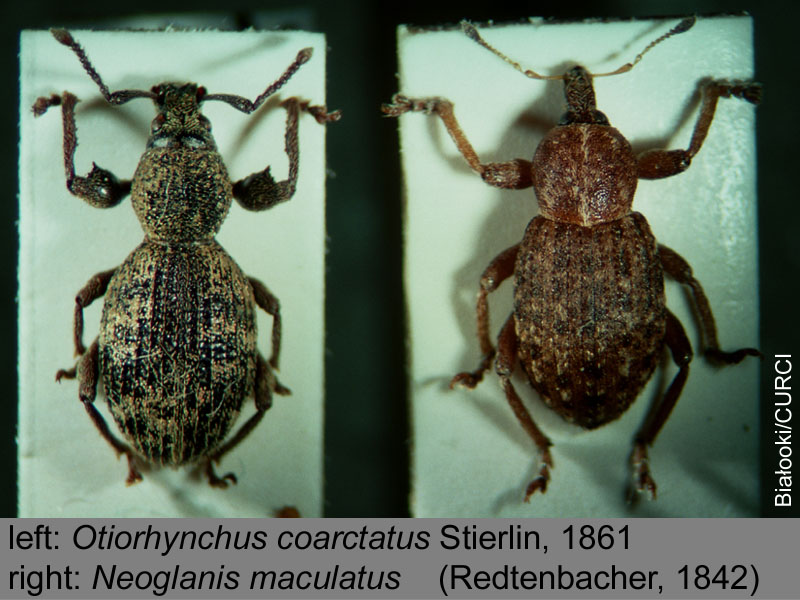
Otiorhynchus
coarctatus
Stierlin, 1861 [Fig. W29.8]:
left;
*Beskid Wschodni: Przemyśl,
27.05.1984, 2exx.
So far, known in
Poland from Pieniny Mts. and Poprad river valley only, about 200km W of Przemyśl.
It is hard to say if there is a real disjunction between these localities and
the present one. If so, western localities would be the result of migration of O.
coarctatus across Carpathians, while eastern locality (Przemyśl) would
be connected with migration route along outer (northern) slopes of Carpathians
as Petryszak presumes for other species [Petryszak 1982]. In favour of this
hypothesis seems to be the detection of the species under discussion in Kamjanec
Podilskij (Ukraine, Podolia, 25.06.1996, 1ex., leg. P. Bialooki), east of
Carpathians. Another record from outer side of Carpathians in Ukraine is Wołowa
Mt. in Miodobory Range [Mazur & Kuśka 1995]. Locality Szin, given
by Endroedi turned out to be absent on maps available for me [Endroedi 1961],
but with high level of probability it is located inside Carpathian Basin.
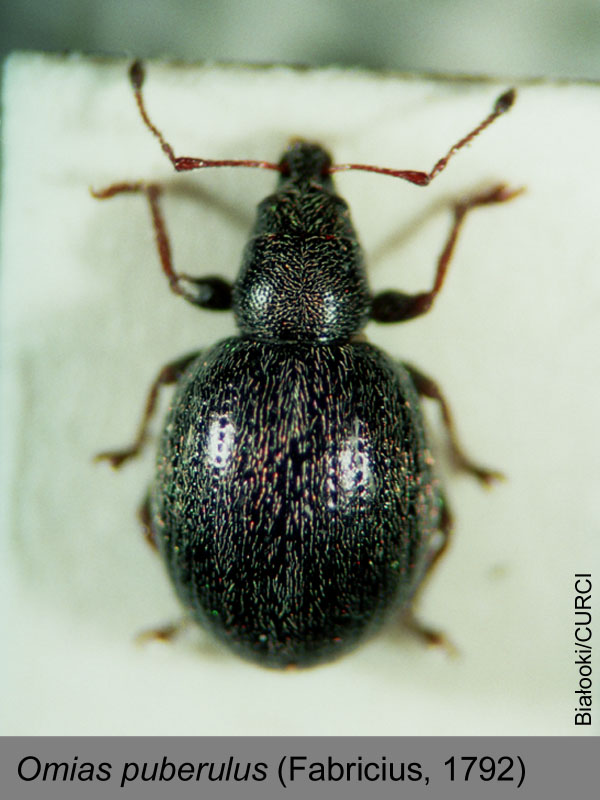
Omias
puberulus Boheman, 1843 [Fig.
W29.9]
Pojezierze Pomorskie: Swiecie,
11.07.1996, 1ex.
Nizina Wielkopolsko- Kujawska:
Toruń, 12.06.1992, 3exx.; 10.05.1993, 12exx.
In Poland, known
from southern part of the country. In the north probably along Vistula river
valley only. The name puberulus Boh. instead of
rotundatus F. after [Alonso-Zarazaga & Lyal 1999].
Liophloeus
tessulatus
(Mueller, 1776)
Pojezierze
Pomorskie: Babi Dół reserve (SE Kartuzy), 24.07.1995, 1ex.;
Pojezierze
Mazurskie: Solanka (N Kętrzyn),
01.07.1978, 1ex.
Brachysomus
setiger (Gyllenhal,
1840)
Pobrzeże Bałtyku:
Pszczółki (NW Tczew), 14.06.1993, 2exx.;
*Pojezierze Pomorskie: Swiecie,
11.07.1997, 7exx.;
Nizina Wielkopolsko-Kujawska:
Mała Nieszawka (W Toruń), 24.07.1997, 1ex.; Złotoria (E Toruń),
21.06.1992, 1ex.
Documented
localities of the species lie in southern and middle parts of Poland only.
Recorded from Gdańsk in 19th century,
but Burakowski et al. comment: Probably basing on misidentification
[Burakowski et al. 1993]. Wanat expressed the same opinion [Wanat 1994]. In the
light of hereby given data, there is no basis to question this old record. An
excellent example of the role of Vistula river valley as migration route.
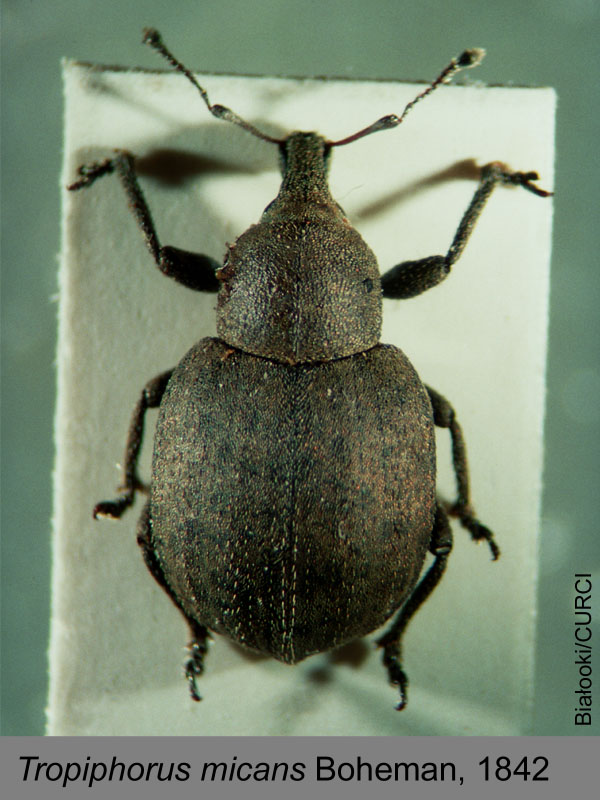
Tropiphorus
micans Boheman, 1842 [Fig.
W29.10]
Beskid Zachodni: Muszyna,
19.06.1995, 1ex.
Very rare
species, with the same distribution pattern in Poland as Otiorhynchus
coarctatus (see above) and identical questions concerning origin of Polish
populations.
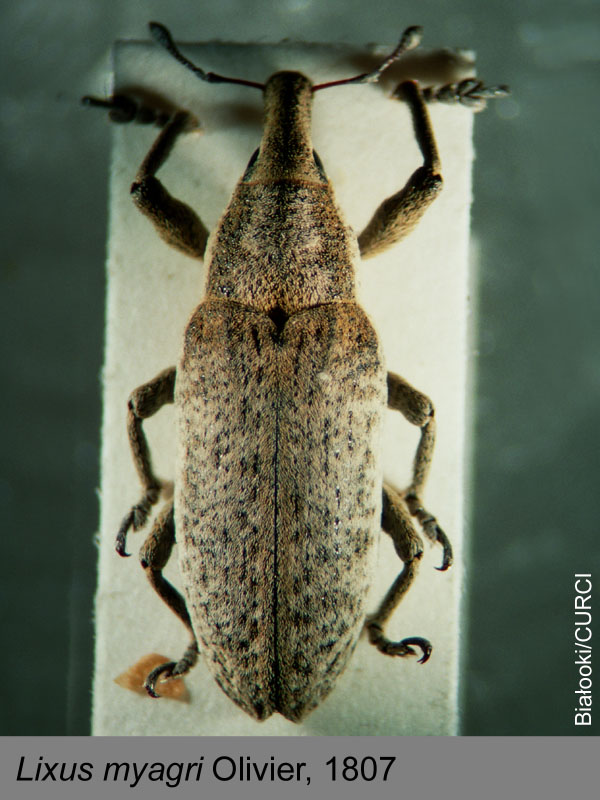
Lixus
myagri Olivier, 1807 [Fig. W29.11]
Nizina Wielkopolsko-Kujawska:
Toruń-Podgórz, 17.05.1993, 1ex.
Neoglanis
maculatus
(Redtenbacher, 1842) [Fig. W29.8]:
right;
Beskid Zachodni: Leluchów (S
Muszyna), 03.07.1995, 1ex.
The name Neoglanis
Alonso-Zarazaga & Lyal, 1999 instead of Donus
Jekel, 1865 after [Zaslavskij 1959] and [Alonso-Zarazaga & Lyal 1999].
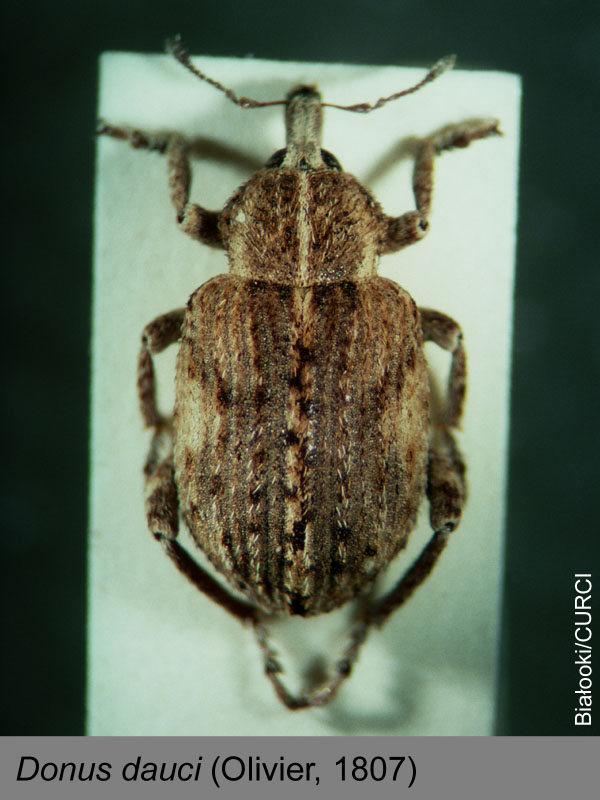
Donus dauci
(Olivier, 1807) [Fig. W29.12]
Pojezierze Pomorskie: Nowy
Barkoczyn (E Kościerzyna). 23.05.1993, 1ex.
The second known
locality in this region.
Pseudophloeophagus
aeneopiceus (Boheman, 1845)
*Pobrzeże Bałtyku:
Gdańsk, 08.03.1981, 8.exx.; 15.10.1990, 2exx.
Extremely rare
species in Poland - known from 3 localities only. In Gdańsk, in both cases,
collected from a wooden basement construction.
Pselactus
spadix (Herbst, 1795)
Pobrzeże Bałtyku: Gdańsk,
20.01.1993, 33exx.
Collected
in the same circumstances as previous species.
Rhyncolus
punctatulus Boheman, 1838
*Pobrzeże Bałtyku:
Gdańsk, Sopot, 1989-1993, > 200exx.
In Gdańsk
and Sopot the species occurs in abundance, but only on street trees. Polyphagous
feeder on many species of deciduous trees, including introduced Acer
negundo L. from North America.
Phloeophagus
turbatus
Schoenherr, 1845
*Pobrzeże Bałtyku:
Gdańsk, 17.12.1990, 3exx. in a stump of Aesculus hippocastanum L.
Bagous
longitarsis Thomson, 1868
*Pojezierze Pomorskie:
Grabowskie Lake (E Kościerzyna), 10.11.1999, 34 exx.
One
out of a few weevil species, collected far more frequently in northern Poland
than in the south of the country.
Bagous
glabrirostris (Herbst, 1795)
*Pojezierze
Pomorskie: Sitno (E Kartuzy), 12.11.1999, 3exx.; 27.11.1999, 2exx.
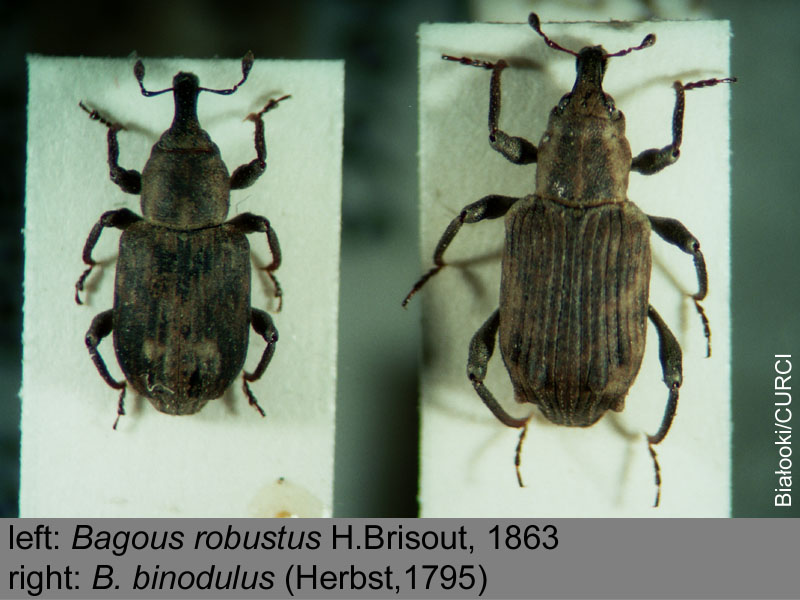
Bagous robustus H. Brisout, 1863 [Fig.
W29.13]: left;
*Pojezierze Mazurskie: Olsztyn,
01.06.1979, 1ex.; 02.04.1980, 1ex.; 21.04.1980, 1ex.; 30.04.1980, 1ex.
Bagous
binodulus (Herbst,
1795) [Fig.W29.13]:
right;
*Pojezierze Pomorskie: Sitno (E
Kartuzy), 12.11.1999, 2exx.; 27.11.1999, 1ex.;
Tychius
trivialis Boheman, 1843
*Pobrzeże Bałtyku:
Gdynia-Kolibki, 05.09.1996, 4exx.
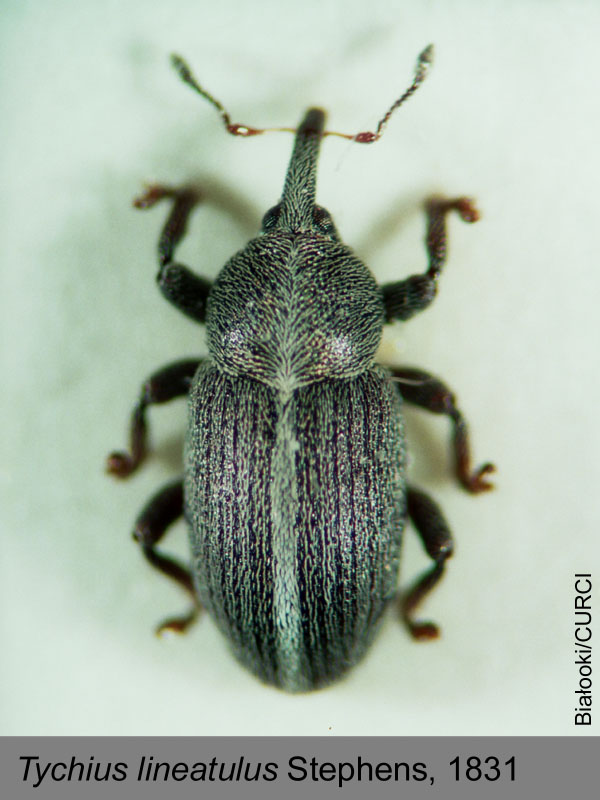
Tychius
lineatulus Stephens,
1831 [Fig. W29.14]
*Pojezierze Pomorskie:
Gorzuchowo (S Grudziądz), 08.08.1995, 2exx.
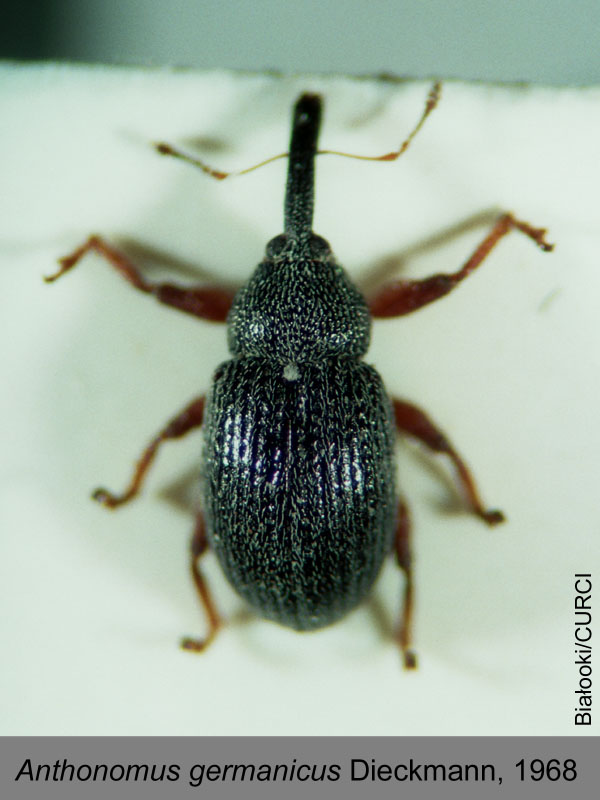
Anthonomus
germanicus Dieckmann,
1968 [Fig. W29.15]
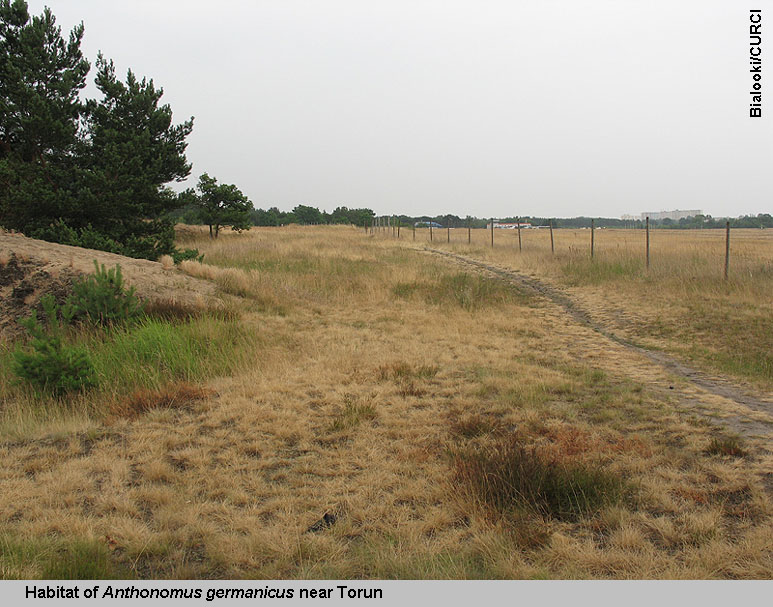
*Nizina Wielkopolsko-Kujawska:
Toruń, 12.06.2003, 1ex.; leg. T.Konefał; 21.04.2004, 4exx.; leg.
T.Konefał & P.Białooki. Habitat: [Fig.
W29.19]
Nearest known
localities of this non-winged species are in the vicinity of Cracow i.e. 300 km
to the south. Moreover, Mazur guesses that two localities within Cracow probably
do not exist any longer [Mazur 2001]. A. germanicus
Dieckm., a rare and local species, is known to occur in the area between middle
Germany and lower Volga river. Probably an oligophagous feeder on Potentilla
L. - records of P. arenaria Borkh. and P.
verna L. are known [Burakowski et al. 1995], so the probability of
introduction with host plant is minute. In Toruń, found on P. arenaria
growing there in large areas.
Recently, another
species of the subgenus Anthonomidius Rtt. was detected in northern
Poland for the first time [Wanat, Szypula 1998] - A. rubripes Gyllenhal,
1836. Nearest known localities of this species are located in Slovakia. In both
cases, origin of such isolated populations remains completely obscure.
Acallocrates
colonnellii Bahr, 2004
*Pobrzeże Bałtyku:
Sopot, 17.04.1998, 1ex.
Recorded as A.
denticollis (Germar, 1824) [Burakowski et al. 1995]. Despite several
subsequent attempts, this is the only specimen from the locality cited. It was
found under unusual circumstances - under the bark of Aesculus hippocastanum L.
ca 1.5 m above ground level, on the edge of a mixed forest.
Given by former
German authors, e.g. [Reitter 1916] from Prussia. In Poland, so far,
documented data exclusively from the very south of the country. It is hard to
explain possible disjunctive occurrence of A. colonnellii along southern
Baltic Seashore. Possibly, the species under discussion occurs in middle Poland,
too. On the other hand, selected forests in the middle of Poland were recently subject to very comprehensive field
researches, but with no results as far as Acallocrates Rtt. is concerned.
Eubrychius
velutus
(Beck, 1817)
*Pojezierze Pomorskie:
Grabowskie Lake (E Kościerzyna), 10.11.1999, 34exx.
Pelenomus
leucogaster (Marsham,
1802)
*Pojezierze Pomorskie:
Grabowskie Lake (E Kościerzyna), 10.11.1999, 4exx.
Rhinoncus
henningsi Wagner, 1936
*Pobrzeże Bałtyku:
Gdynia- Kolibki, 31.07.1996, 3exx.; 04.08.1996, 31 exx.
Pojezierze Pomorskie: Kiełpino
(S Kartuzy), 12.08.1995, 7exx.; 17.08.1995, 24exx.;
Nizina Wielkopolsko-Kujawska:
Mała Nieszawka (W Toruń), 15.05.1997, 23 exx.
Species not
recorded from northern and middle Poland by former authors. Relatively not far
ago described, and then it remained little known for a long time. Only recently
a number of new localities with usually abundant populations were detected.
Homorosoma
validirostre (Gyllenhal, 1837)
*Pobrzeże Bałtyku:
Gdynia, 14.07.1995, 3exx.; swept from Polygonum amphibium L. at a dry,
somewhat ruderal place.
Wyżyna Małopolska:
Chotel Czerwony (S Busko-Zdrój), 06.06.1998, 4exx.
Collected in
similar circumstances as previous species. Probably Polygonum amphibium
is a host plant of H. validirostre
(Gyll.).
Thamiocolus
vidutus
(Gyllenhal, 1813)
*Pobrzeże Bałtyku:
Marszewo Lake (SW Ustka), 24.11. 1999, 1ex.
Ceutorhynchus
dubius Ch. Brisout, 1883
Pojezierze
Pomorskie: Lębork, 06.08.1995, 1ex.;
*Nizina Wielkopolsko-Kujawska:
Toruń, 17.05.1992, 1ex.
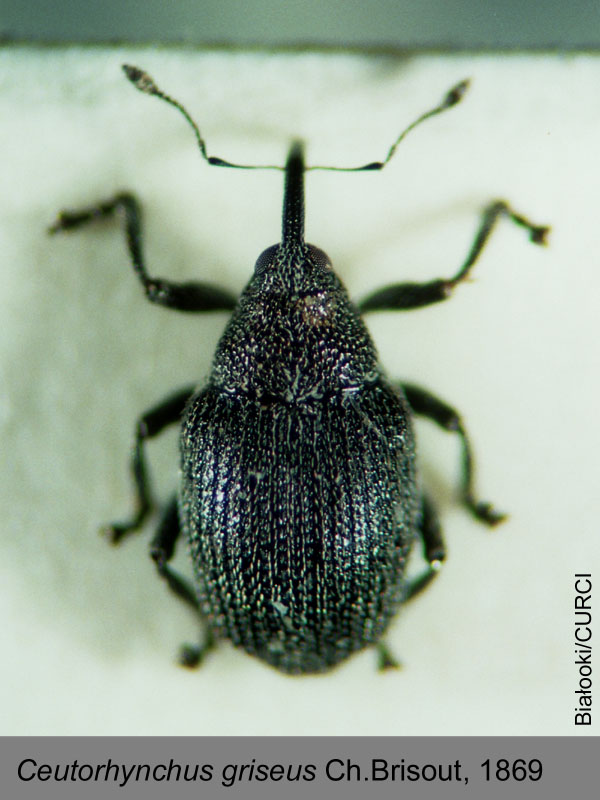
Ceutorhynchus
griseus Ch. Brisout,
1869 [Fig. W29.16]
Pojezierze Pomorskie: Nowe
Polaszki (SE Kościerzyna), 26.07.1995, 1ex.
The second
locality of this rare species in Pomorskie Lakeland.
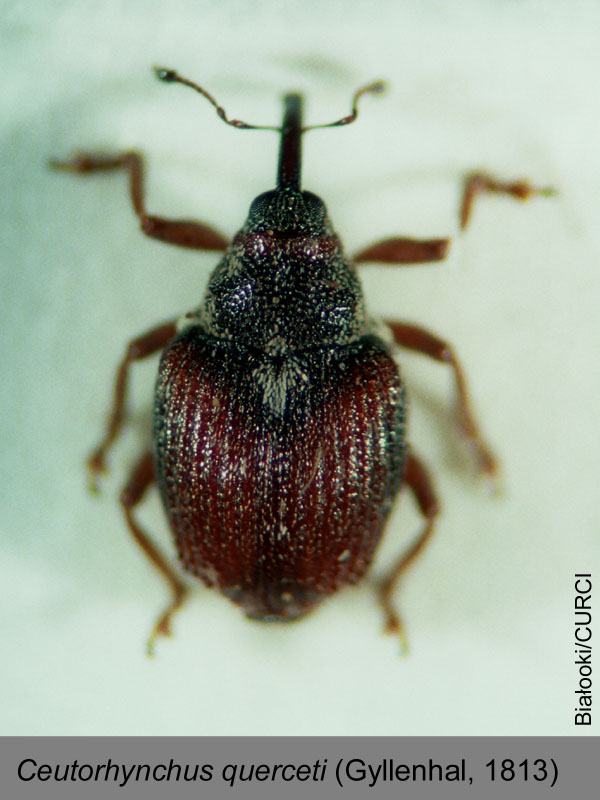
Ceutorhynchus
querceti
(Gyllenhal, 1813) [Fig. W29.17]
*Nizina Wielkopolsko-Kujawska:
Złotoria (E Toruń), 21.06.1995, 1ex.
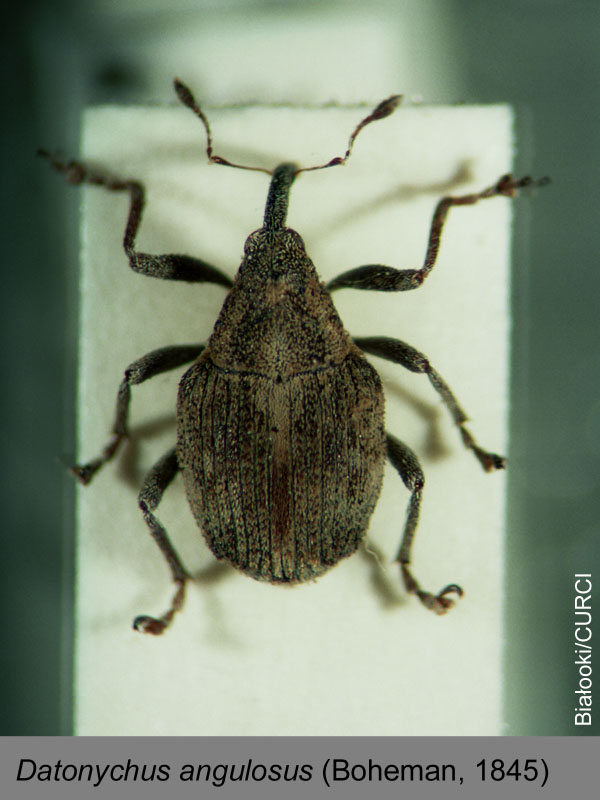
Datonychus
angulosus (Boheman,
1845) [Fig. W29.18]
*Pojezierze Pomorskie: Miszewo
(N Żukowo), 14.11.1999, 1ex.; Hutowe Lake SE Kościerzyna), 26.07.1995,
1ex.
Datonychus
arquatus (Herbst, 1795)
*Pojezierze Pomorskie:
Tuchomskie Lake (W Sopot), 15.08.2000, 34exx.; Babi Dół reserve (SE
Kartuzy), 2exx.
Microplontus
melanostigma (Marsham,
1802)
Pojezierze Pomorskie: Grudziądz-Mniszek,
01.08.1995, 5exx.; 08.08.1995, 4exx.;
*Nizina Wielkopolsko-Kujawska:
Toruń; Włocławek, May-Juli 1992-1993,> 50exx.
In Poland,
distinguishable from closely allied M. rugulosus (Herbst, 1795); differs
from that species by external morphology, structure of aedeagus and biology -
connected with Artemisia vulgaris L. and A. absinthium
L. [Smreczyński 1974], whereas C.
rugulosus with Matricaria L. My specimens of M. melanostigma
were collected almost exclusively from A. vulgaris. M. melanostigma, once
recognized as rare species, is actually common, I collected it far more
frequently than M. rugulosus. M. figuratus Gyllenhal, 1837 was
synonymized with M. rugulosus by Abbazzi et al. and Colonnelli with no
comments [Abbazzi et al. 1995]; [Colonnelli 1998]. Wanat & Mokrzycki
explained the case in detail [Wanat, Mokrzycki 2005].
Trichosirocalus
horridus
(Panzer, 1801)
Pobrzeże Bałtyku: Gdańsk-Lipce,
01.08.1996, 1ex.
The second
locality of this species in Gdańsk, 10km south of the first one [Burakowski
et al., 1997] The species shows a curious distribution pattern in Poland - other
known localities are located in southern part of the country.
Calosirus
apicalis
(Gyllenhal, 1827)
*Nizina
Wielkopolsko-Kujawska: Złotoria (E Toruń), 21.06.1995,
1ex.
Mecinus
janthinus Germar, 1821
*Pobrzeże Bałtyku:
Gdynia, 14.07.1995, 1ex.; 16.08.2003, 1ex.
Pseudorchestes
pratensis (Germar,
1821)
*Pojezierze Pomorskie:
Gorzuchowo (S Grudziądz), 08.08.1995, 21 exx.
Pseudorchestes
ermischi (Dieckmann,
1958)
*Pojezierze Mazurskie: Olsztyn,
15.05.1979, 1ex.; 17.05.1979, 6exx.; 27.05.1980, 1ex.; Hartowiec (NW Działdowo),
28.07.1996, 1ex.; 02.08.1996, 5exx.
Pseudorchestes
smreczynskii
(Dieckmann, 1958)
*Pojezierze Pomorskie: Gruczno
(N Bydgoszcz), 20.08.1996, 12exx.
Pojezierze Mazurskie: Hartowiec
(NW Działdowo), 02.08.1996, 19exx.
Species detected
in Poland only recently. Recorded from several localities in eastern Poland
[Wanat, Szypula 1998]. Population in Gruczno was discovered by M. Mazur
(Cracow).
Alonso-Zarazaga
M. A., Lyal Ch. H. C. (1999): A World Catalogue of Families and Genera of Curculionoidea (Insekta:
Coleoptera) (Excepting Scolytidae and Platypodidae). Entomopraxis,
Barcelona, 315 pp.
Abbazzi
P., Colonnelli E., Masutti L., Osella G. (1995):
Coleoptera Polyphaga XVI (Curculionoidea). In: Minelli A., Ruffo S., La Posta
S. (eds): Checklist delle specie della Fauna italiana, 61.Calderini,
Bologna, 68 pp.
Burakowski B., Mroczkowski
M., Stefańska J. (1992):
Chrząszcze (Coleoptera)- Ryjkowcowate prócz ryjkowców- Curculionoidea prócz Curculionidae.
Katalog Fauny Polski, 51 (część XXIII, tom 18), 324 pp.
Burakowski B. Mroczkowski M.
Stefańska J. (1993):
Chrząszcze (Coleoptera)- Ryjkowce- Curculionidae,
część 1. Katalog Fauny Polski, 52 (część
XXIII, tom 19), 304 pp.
Burakowski B. Mroczkowski
M., Stefańska J. (1995):
Chrząszcze (Coleoptera)- Ryjkowce- Curculionidae,
część 2. Katalog Fauny Polski, 54 (część
XXIII, tom 20), 310 pp.
Burakowski B., Mroczkowski
M., Stefańska J. (1997):
Chrząszcze (Coleoptera)- Ryjkowce- Curculionidae,
część 3. Katalog Fauny Polski, 56 (część
XXIII, tom 21), 307 pp.
Cmoluch Z. (1991):
Otiorhynchus porcatus (Herbst, 1795) (Col., Curculionidae) - gatunek
ryjkowca rzadki dla fauny Polski. Przegl. Zool., XXXIV (2-3): 287-290.
Colonnelli E. (1998):
Systematic and synonymic notes on Ceutorhynchinae, with lectotype and neotype designations, and descriptions of three new
genera. Fragm.
Ent., 30(1):
105-175.
Colonnelli E. (2003): A revised checklist of Italian Curculionoidea
(Coleoptera). Zootaxa, 337: 1-142.
Dieckmann L. (1977):
Beitraege zur Insektenfauna der DDR: Coleoptera - Curculionidae (Apioninae). Beitr. Ent. 27: 7-143.
Dieckmann L.
(1980): Beitraege zur Insektenfauna der DDR: Coleoptera - Curculionidae
(Brachycerinae, Otiorhynchinae, Brachyderinae). Beitr. Ent. 30: 145-310.
Endroedi
S. (1961):
Bestimmungstabelle der Otiorhynchus-Arten des Karpaten-Beckens
(Coleoptera - Curculionidae), Ostrava, 123 pp.
Kania J., Zawadzki J. (1994):
Nowe stanowiska polskich ryjkowców z rodzaju Otiorhynchus
Germar, 1824 (Coleoptera, Curculionidae). Wiad. Ent.13 (4): 259-260.
Łomnicki M. (1913):
Wykaz chrząszczów czyli Tęgopokrywych (Coleoptera) ziem polskich
(Catalogus Coleopterorum Poloniae). Kosmos, Lwów. 38: 21-155.
Magnano L. (2001):
Designation of lectotypes for species of Cirrorhynchus
Apfelbeck, 1898, Dodecastichus
Stierlin, 1861, Limatogaster
Apfelbeck, 1898, Otiorhychus Germar,
1822 and Tylotus Schoenherr, 1823, in
the Germar and Herbst collections (Coleoptera, Curculionidae). Mem.
Soc. Ent. Ital., 80: 139-158.
Mazur M.
(2001):
Ryjkowce kserotermiczne Polski (Coleoptera: Nemonychidae, Attelabidae,
Apionidae, Curculionidae).
Studium Zoogeograficzne. In: Monografie Fauny Polski, 22: 1-378.
Mazur M., Kuśka A.
(1995): Chrząszcze
Miodoborów (Zachodnia Ukraina). I. Ryjkowce (Coleoptera: Attelabidae,
Apionidae, Curculionidae) - wyniki ekspedycji w latach 1993- 1994. Pol. Pismo
Ent. 63: 277-
310.
Petryszak B. (1982):
Ryjkowce (Curculionidae, Coleoptera) Beskidu Sądeckiego. In: Rozprawy
habilitacyjne UJ. Kraków, nr 68: 1- 204.
Reitter
E. (1916): Fauna Germanica.V. Stuttgart, 343 pp.
Smreczyński S. (1974):
Ryjkowce- Curculionidae: Podrodzina Curculioninae. In: Klucze do oznaczania owadów
Polski. 83 (XIX, 98 e) 195 pp.
Wanat M. (1994):
Ryjkowce (Coleoptera: Curculionoidea: Anthribidae, Rhinomaceridae, Rhynchitidae,
Attelabidae, Apionidae, Curculionidae) Puszczy Białowieskiej. Pol. Pismo
Ent. 63: 37-112.
Wanat M., Szypuła J.
(1998): Interesujące
gatunki ryjkowców (Coleoptera: Urodontidae, Curculionidae) ze wschodniej
Polski. Wiad. Ent. 17 (2): 85- 94.
Wanat M.,
Mokrzycki T. (2005): A new checklist of the weevils of Poland (Coleoptera:
Curculionoidea).Genus, 16(1): 69-117.
Zaslavskij V. A. (1959):
O nadrodovykh gruppirovkakh v tribe Hyperini (Coleoptera, Curculionidae). Entomol.
Obozr., 38(3): 652-654.
Address
of the author:
State
Plant Health and Seed Inspection Service
Border Division
Gdynia
81-336 Gdynia,
Dokerow 5 Street
P.O. Box 245,
Poland
e-mail: og-gdynia@piorin.gov.pl
(office)
pbialooki@poczta.onet.pl
(personal)