The weevil Stenopelmus rufinasus, indigenous to southern and western USA, is recorded for the first time from Slovakia. It was found on young sprouts of water milfoil (Myriophyllum sp.) at the edge of an old drying river bed near the Váh River, although the plant is not believed to be a host. This species was expected to occur in Slovakia, because its known host, the invasive Azolla filiculoides, is well known from south-western Slovakia since the 1980s. So far the weevil is known from West Europe, Middle Europe, the western part of southern Europe, and in the east from Ukraine.
Nosatec Stenopelmus rufinasus, druh původní v jižní a západní části USA, je poprvé hlášen ze Slovenska. Byl nalezen na mladých lodyhách stolístku (Myriophyllum sp.) na okraji vysychajícího mrtvého ramene řeky Váh, ačkoli se s největší pravděpodobností nejednalo o živnou rostlinu. Výskyt druhu na Slovensku byl očekáván, protože jeho hostitelská rostlina, invazní azola americká (Azolla filiciuloides), je na jihozápadním Slovensku dobře známá již od 80 let minulého století. Na uvedené lokalitě tato drobná kapradina nebyla nalezena, avšak mohla být přehlédnuta. Dosud byl druh znám jen ze západní, střední a části jižní Evropy, na východě pouze z Ukrajiny.
Curculionoidea, Slovakia, faunistics, Stenopelmus rufinasus, Azolla, Myriophyllum.
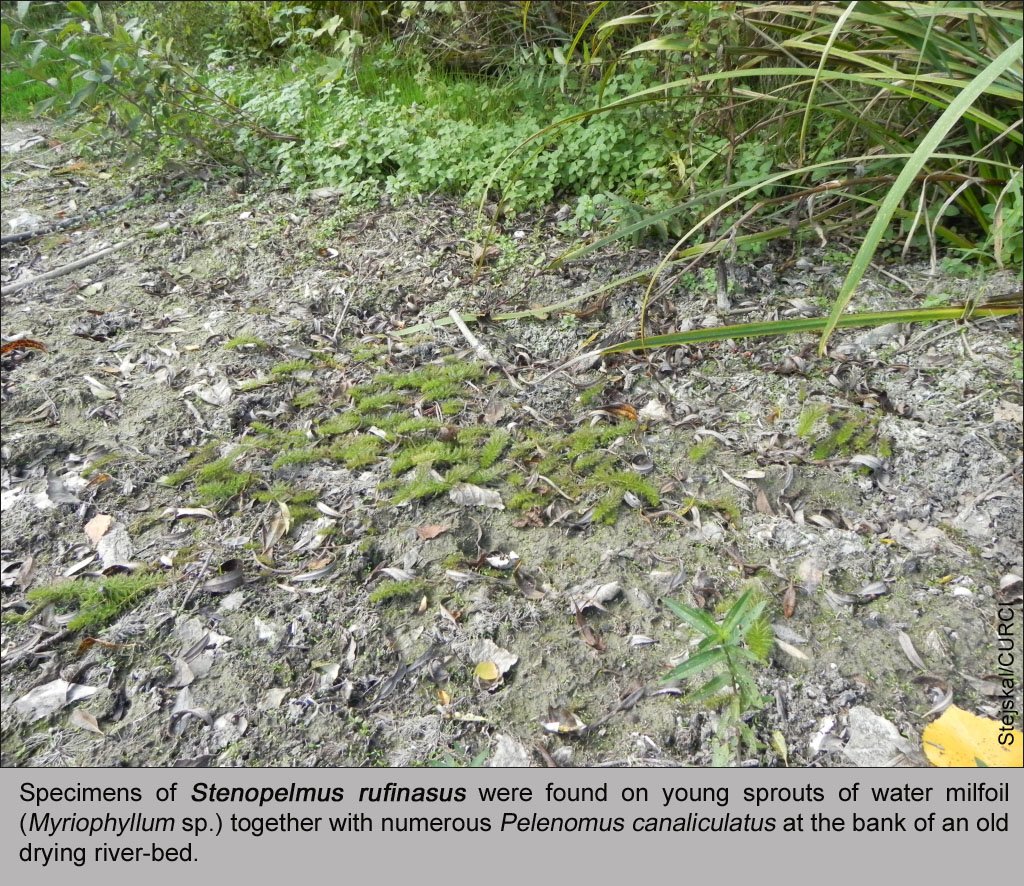
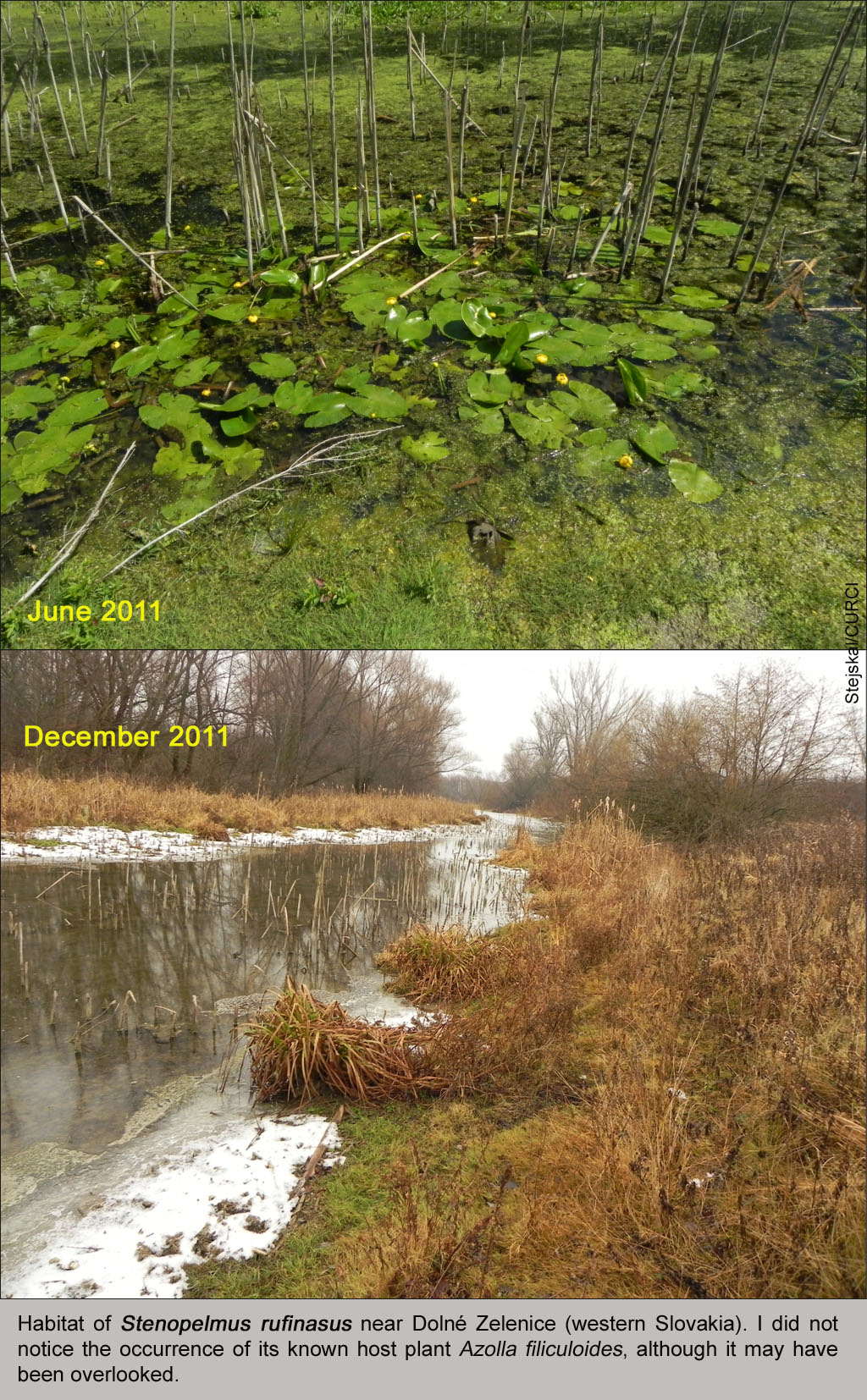
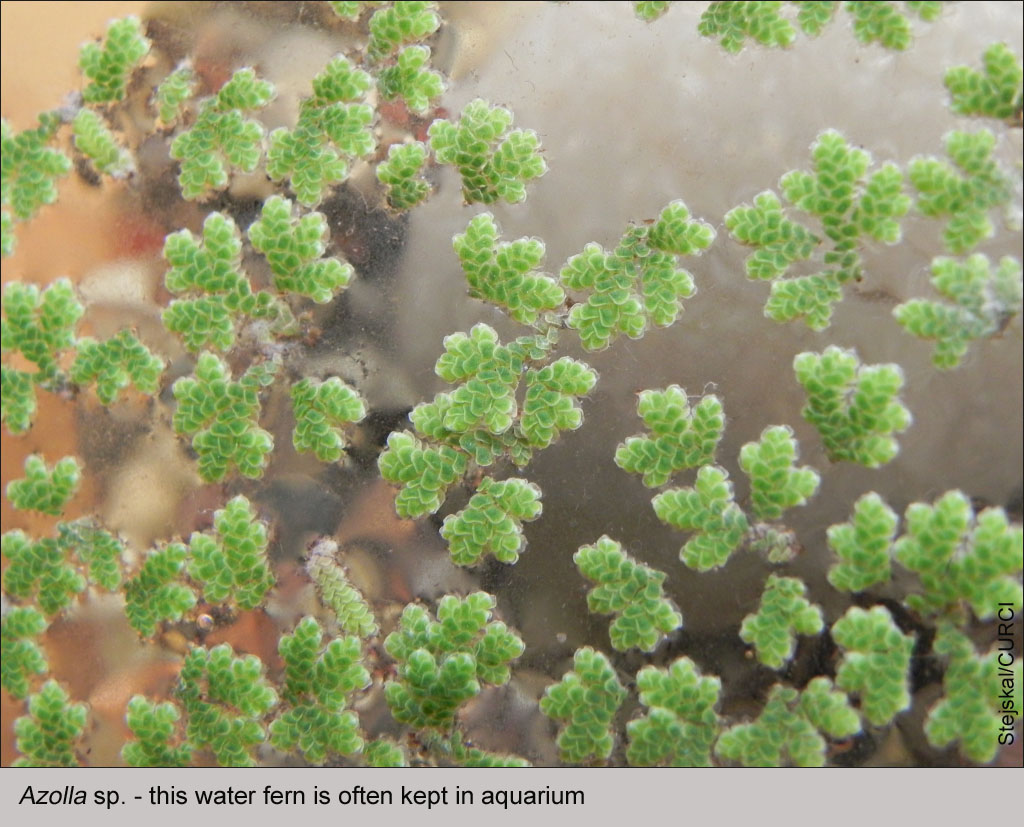
During a short visit of a wetland locality near the Váh River in western Slovakia in October 2011 I found several specimens of a weevil unknown to me. The specimens were sitting on young sprouts of water milfoil (Myriophyllum sp.) together with numerous Pelenomus canaliculatus (Fahraeus) at the edge of an old drying river-bed [Tab. W74.01] [Tab. W74.02]. At first sight the weevils reminded of a very small Bagous species. Later in the laboratory I identified the weevil as Stenopelmus rufinasus Gyllenhal, 1835, an introduced species from Nearctic region associated with North American mosquito ferns (Azolla spp.) [Tab. W74.03].
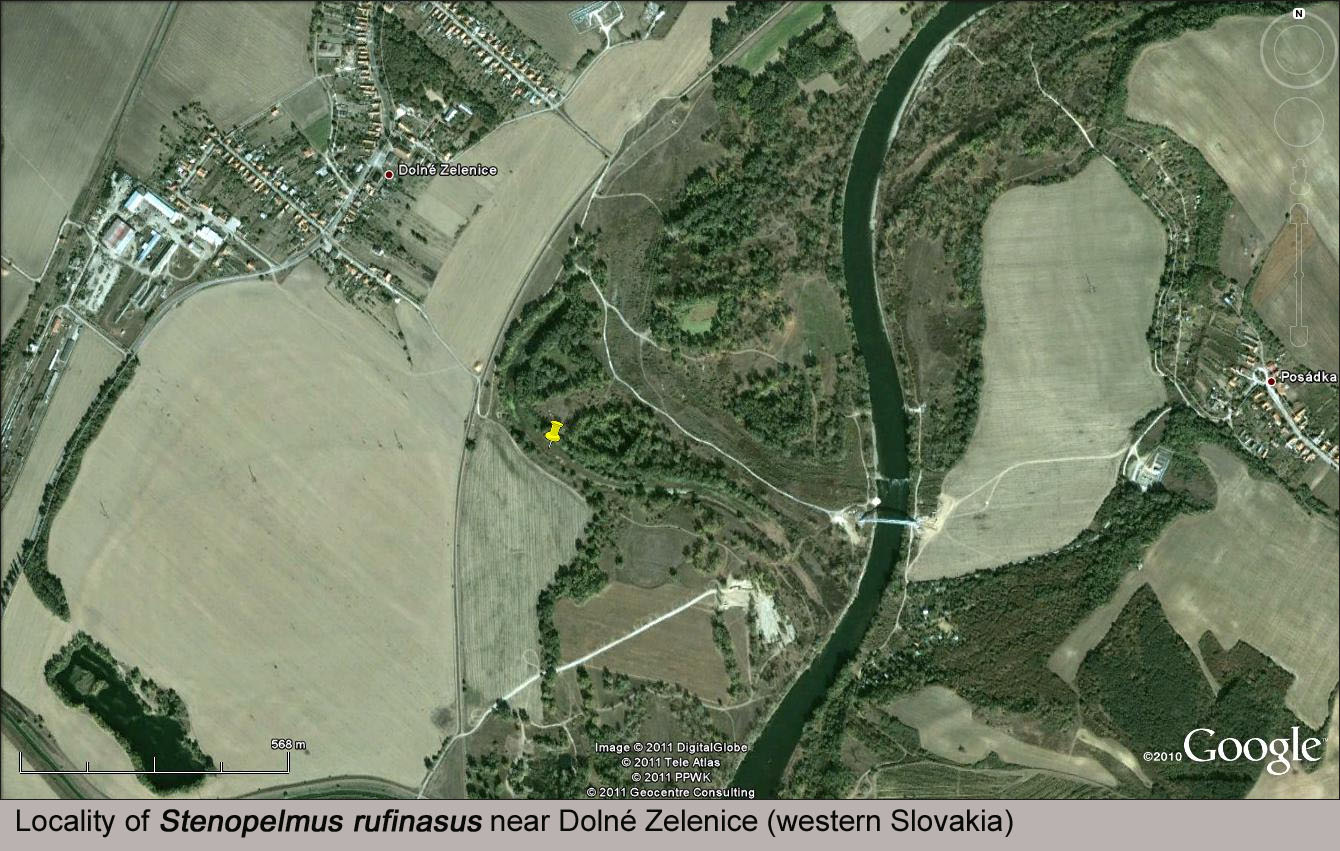
Material collected: Slovakia occ., 0.7 km SE of Dolné Zelenice (48°22'13.95"N, 17°45'8.62"E) [Tab. W74.04], old river-bed of the Váh River, 135 m a. s. l., on Myriophyllum sp., 2.x.2011, 6 ex., hand-collecting, R. Stejskal lgt., det., J. Krátký revid., 3 ex. in coll. R. Stejskal, 1 ex. in coll. J. Krátký, 2 ex. in coll. Curculio Institute, Mönchengladbach, Germany (system 1+1).
The association with Myriophyllum was most likely accidental, all other known records being from ferns, particularly Azolla species. The old river-bed was drying very rapidly due to a long period of drought, and therefore the water weevils were forced to search for alternative shelters. During some four visits to the locality through the year I did not notice the occurrence of its known host plant Azolla filiculoides, although it may have been overlooked since I am unfamiliar with this plant. However, its occurrence there is very probable because the plant has been established in the Lower Váh Region and at other localities in Danubian Lowland since the 1980s (see http://sbs.sav.sk/atlas/detail.php?rowid=115, [Eliáš 1981]).
The species is absent from the current check-list of Czech and Slovakian weevils [Benedikt et al. 2010], thus in this paper, the weevil Stenopelmus rufinasus is recorded for the first time from Slovakia.
S. rufinasus is indigenous to southern and western USA [LeConte 1876], [O´Brien & Anderson 1996], but it has also been recorded in southern America [Hill 1998], and has been accidentally introduced to Europe with the imported aquatic fern Azolla (Azollaceae) [Janson 1921], [Suavard 2010]. In Janson`s opinion [Janson 1921], the beetle was carried in the egg or pupal stage, attached to the host plant, this being carried on the feet of migratory water birds; this has not been supported by observations.
The first European record of the weevil is from France at the end of 19th century, from where it was mistakenly described by Bedel [Bedel 1901] as Degorsia champenoisi.
During the 20th and 21st centuries, the species has been recorded in other countries (e.g. Great Britain: [Janson 1921], [Ashe 1939], Germany: [Manzek 1927], Spain: [Carrillo et al. 2005], Hungary: [Podlussány 2001]). Currently it is known from the western, central and southern parts of Europe (Belgium, France, Great Britain, Germany, Slovakia, Hungary, Ireland, Italy, the Netherlands and Spain); in the East it is known from Ukraine, in Asia it occurs in Japan, and it has been imported to southern Africa [Caldara 2011].
The weevil Stenopelmus rufinasus appears to be a specialized feeder on North American mosquito ferns, Azolla spp. (Azollaceae) [Richerson & Grigarick 1967], [Hill 1998]. In America, the weevil occurs on A. caroliniana Willd., A. filiculoides Lam. [Richerson & Grigarick 1967], and also on A. pinnata R. Br., an Old World invasive species in Florida [Pemberton & Bodle 2009]. A. filiculoides has invaded Europe and southern Africa, where it has become an important weed [Hill 1998]. The means of introduction is unknown, although in southern Africa A. filiculoides may have been an aquarium plant poured into a river [Jacot Guillarmod 1979]. In America, A. pinnata was probably introduced through aquatic plant commerce [Pemberton & Bodle 2009].
Invasive Azolla species are considered serious aquatic weeds in water ecosystems [Pemberton & Bodle 2009], [Sheppard et al. 2006].
S. rufinasus was introduced to southern Africa in 1995 as potential natural enemy for invasive Azolla filiculoides [Hill 1998]. The introduction was very successful and the weevil contributed to the local extinction of A. filiculoides at 81 % of the 112 release sites [McConnachie et al. 2004]. To a lesser extent, it has also been used for biological control in the British Isles [Kelly & Maguire 2009]. Compared to southern Africa, in Europe the weevil has been less effective in biocontrol of the weed [Sheppard et al. 2006].
The life history was studied in detail by [Hill 1998], and some biological notes were provided by [Brocher 1912]. Adults of S. rufinasus live approximately 55 days. The development from the egg to the adult stage takes about 20 days, so that the weevil has several generations per year. In the laboratory, both adults and larvae caused severe damage to A. filiculoides, which seems to be the most suitable host for this weevil. Feeding, oviposition and larval development were only recorded on Azolla species (other 31 plant species from 19 families were not attacked).
Very interesting bionomic notes are provided by [Rheinheimer & Hassler 2010]. In the northern floodplain of the Rhine River, they observed the weevil feeding on Salvinia natans (L.) All. (Salviniaceae). This plant is very closely related to Azolla, and sometimes considered to belong to the same family. Moreover, the beetles have been found in areas where no Azolla occurs, such as for example salt marshes on the coast of Schleswig-Holstein (e.g. Sankt Peter-Ording, 21.viii.1990, 1 ex., sifting of drift line = Sturmflutgesiebe, W. Ziegler lgt., R. Suikat, in litt.). Similar findings come from the Île d'Oléron in southwestern France (June 1992, R. Suikat lgt., det. et coll.) where S. rufinasus was sifted in large numbers from the drift line, while no Azolla occur on the island (R. Suikat, in litt.). A single specimen has even been collected at 1600 m a.s.l. in southern France, most probably transported by the wind. [Rheinheimer & Hassler 2010] assume that the weevil S. rufinasus is most likely not strictly monophagous on Azolla, but there must be an alternative host which allows the species to survive.
However, there is another explanation that seems more probable. In Peter Sprick’s opinion (in litt.), findings of S. rufinasus in the areas where no Azolla occur may be explained by spreading specimens that explore new places to colonize. At their original habitats, these beetles can reproduce very fast and soon their population is high enough to eradicate their host. Afterwards, they are forced to search for new Azolla sites and that is why they move in huge numbers through the air. Many of them fly over the water, fall down and are washed to the seashore. Single specimens may be drifted by winds to the mountains.
I would like to thank Peter Sprick (Hannover) for his useful comments on the manuscript and help with literature sources, and Chris Lyal for linguistic corrections. Mr. Roland Suikat is thanked for providing some collection data. Preparation of this paper was supported by EU funds and the state budget of the Czech Republic within a research project nr. CZ.1.07/2.3.00/20.0004 titled “Vytvoření a rozvoj multidisciplinárního týmu na platformě krajinné ekologie”
Ashe, G. H. (1939): Stenopelmus rufinasus Gyll. (Col., Curculionidae). - Entomologist's Monthly Magazine, LXXV: 249; London.
Bedel, L. (1901): Description et moeurs d´un nouveau genre de Curculionides de France. - Bulletin de la Société Entomologique de France, 6: 358-359; Paris.
Benedikt, S., Borovec, R., Fremuth, J., Krátký, J., Schön, K., Skuhrovec, J., Trýzna, M. (2010): Komentovaný seznam nosatcovitých brouků (Coleoptera: Curculionoidea bez Scolytinae a Platypodinae) České republiky a Slovenska, 1. díl. Systematika, faunistika, historie výzkumu nosatcovitých brouků v České republice a na Slovensku, nástin skladby, seznam. Komentáře k Anthribidae, Rhynchitidae, Attelabidae, Nanophyidae, Brachyceridae, Dryophthoridae, Erirhinidae a Curculionidae: Curculioninae, Bagoinae, Baridinae, Ceutorhynchinae, Conoderinae, Hyperinae. Annotated checklist of weevils (Coleoptera: Curculionoidea excepting Scolytinae and Platypodinae) of the Czech Republic and Slovakia Part 1. Systematics, faunistics, history of research on weevils in the Czech Republic and Slovakia, structure outline, checklist. Comments on Anthribidae, Rhynchitidae, Attelabidae, Nanophyidae, Brachyceridae, Dryophthoridae, Erirhinidae and Curculionidae: Curculioninae, Bagoinae, Baridinae, Ceutorhynchinae, Conoderinae, Hyperinae. - Klapalekiana, 46: 1-363; Praha.
Brocher, F. (1912): Observations biologiques sur quelques Curculionides aquatiques. - Ann. Biol. Lacustre, 5: 180-186.
Caldara, R. (2011): Erirhinidae, p. 192-197. - In Löbl, I. & Smetana, A. (ed.): Catalogue of Palaearctic Coleoptera, Vol. 7. - Apollo Books, 373 pp.; Stenstrup.
Eliáš, P. (1981): Rozšírenie Azolla filiculoides Lam. na Slovensku [Distribution of Azolla filiculoides Lam. in Slovakia]. Zpr. Čs. Bot. Společ., 15: 93-94.
Fernández Carillo, J. L., Fernández Carillo, E., Alonso-Zarazaga, M. A. (2005): Primera cita de Stenopelmus rufinasus Gyllenhal, 1835 en la Península Ibérica (Coleoptera, Erirhinidae). - Graellsia, 61(1): 134-140.
Gyllenhal, L. (1835): Stenopelmus rufinasus. In: C. Schoenherr (ed), Genera et Species Curculionidum, cum synonymia hujus Familiae: Species Novae aut Hactenus Minus Cognitae, Descriptionibus a Dom. Leonardo Gyllenhal, C. H. Boheman, et Entomologis Aliis, Illustratae. - Publisher Roret, Vol. 3(1): 469: Paris.
Hill, M. P. (1998): Life history and laboratory host range of Stenopelmus rufinasus, a natural enemy for Azolla filiculoides in South Africa. - BioControl, 43: 215-224.
Jacot Guillarmod, A. (1979): Water weeds in southern Africa. - Aquatic Botany, 6: 377-391.
Janson, O. E. (1921): Stenopelmus rufinasus Gyll., an addition to the list of British Coleoptera. - The Entomologist´s monthly magazine, 57: 225-226; Oxford.
Kelly, J., Maguire, C. M. (2009): Azolla filiculoides invasive species action plan. Prepared for NIEA and NPWS as part of Invasive Species Ireland. PDF available on: http://invasivespeciesireland.com/ – 14 pp.
Manzek, E. (1927): Stenopelmus rufinasus Gyll., ein für Deutschland neuer Käfer. - Entomologische Blätter 23 (4): 189-191.
McConnachie, A. J., Hill, M. P., Byrne, M. J. (2004): Field assessment of a frond-feeding weevil, a successful biological control agent of red waterfern, Azolla filiculioides, in southern Africa. - Biological Control, 29: 326-331.
LeConte, J. L. (1876): The Rhynchophora of America, North of Mexico. - Proceedings of the conference, Belušské Slatiny, 15: 160-180.
O´Brien, C. W., Anderson, D. M. (1996): A catalog of the Coleoptera of America North of Mexico. Family: Curculionidae, subfamily: Erirhininae. - United States Department of Agriculture, Agriculture handbook number 529-143f: 40.
Pemberton, R. W., Bodle, J. M. (2009): Native American Azolla weevil, Stenopelmus rufinasus (Coleoptera: Curculionida), uses the invasive old world Azolla pinnata as a host plant. - Florida Entomologist, 92(1): 153-155.
Podlussány, A. (2001): Új ormányosalkatú bogárfajok Magyaroszág faunájában (Coleoptera: Curculionoidea) (Curculionid beetle species new for the fauna of Hungary (Coleoptera: Curculionoidea). - Folia Entomologica Hungarica, 62: 372-378.
Richerson, P. J., Grigarick, A. A. (1967): The life history of Stenopelmus rufinasus (Coleoptera: Curculionidae). - Annals of the Entomological Society of America, 60: 351-354.
Rheinheimer, J., Hassler, M. (2010): Die Rüsselkäfer Baden-Württembergs. - Naturschutz-Spectrum, Themen 99, 944 pp. Karlsruhe.
Sheppard, A. W., Shaw, R. H., Sforza, R. (2006): Top 20 environmental weeds for classical biological control in Europe: a review of opportunities, regulations and other barriers to adoption. - Weed Research, 46: 93-117.
Suavard, D., Branco, M., Lakatos, F., Faccoli, M., Kirkendall, L. R. (2010): Weevils and bark beetles (Coleoptera, Curculionoidea). Chapter 8.2. In: Roques, A. et al. (eds.): Alien terrestrial arthropods of Europe. - BioRisk, 4(1): 219-266.