
Within the lexicon, I monitor individual species to see if they are included in one of the recognized lists for the protection of animal species. At the same time, I monitor the inclusion of species in Act Decree No. 395/1992 Coll. In order to obtain an overview of the development of the classification of species into individual protection levels, I also present the older Czech red lists. For each species, I check the inclusion in the following documents:
- Regulation No. 395/92 of Collection
- Red Book of the Czechoslovakia (1992)
- Red List of the Czech Republic (2005)
- Red List of the Czech Republic (2017)
- Council Directive 92/43/EEC (1992)
- IUCN Red List (Europe)
- Berne Convention ETS 104 (1979)
For each document I have created a set of pictograms that show the degree of protection of the species. All pictograms are adjusted so that the lowest degree of threat (and therefore also protection) is on the right side of the pictogram and the greatest degree of threat (protection) is on the left side.
Regulation No. 395/92 of Collection
Regulation of the Ministry of the Environment of the Czech Republic implementing some provisions of Act No. 114/1992 Coll. of the Czech National Council on nature and landscape protection. The validity and effectiveness of the regulation dates from August 13th, 1992.
 Regulation No. 395/92 of Collection
In the framework of this regulation, invertebrates are included in one of three types of endangered species, and accordingly these species will receive the corresponding pictogram in the lexicon:
| CR - Criticaly Endandered |  |
| HE - Highly Endangered |  |
| EN - Endangered |  |
Red Book of the Czechoslovakia 1992
The exact title is "The Red Book of Endangered and Rare Species of Plants and Animals of the Czechoslovakia, Part 3, Invertebrates".
The publication contains a selection of 188 species of endangered molluscs, arachnids, crustaceans and insects. There are 117 insect species, of which 24 are from the Coleoptera order. The IUCN methodology was used for classifying species into protection levels. For invertebrates, the IUCN scale was limited to only two categories - endangered and vulnerable.
In the framework of this publication, invertebrates are classified into one of two types of endangered species, and accordingly these species are given the appropriate pictogram in the lexicon:
| EN - Endangered |  |
| VU - Vulnerable |  |
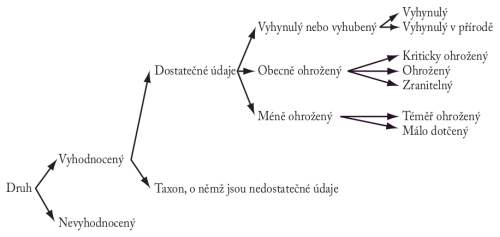 |
| Category structure for the Red Lists (adapted from PRIMACK 2002) |
Red List of the Czech Republic (2005)
The publication describes in great detail the classification of species into the categories of threat, which is based on the IUCN methodology. The classification of species into individual categories was based on the IUCN methodology version 3.1, which was published in 2001. The diagram shows the structure of the links of individual categories according to IUCN version 3.1.
Red List of the Czech Republic (2005)
In the framework of this publication, invertebrates are classified into one of five types of endangered species, and accordingly these species are given the appropriate pictogram in the lexicon:
| RE - Regionally Extinct |  |
| CR - Criticaly Endandered | 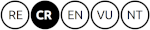 |
| EN - Endangered | 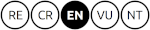 |
| VU - Vulnerable | 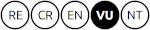 |
| NT - Near Threatened |  |
 |
| The IUCN Category System for Taxon Threat Assessment (IUCN 2012a) |
Red List of the Czech Republic (2017)
This updated Red List uses the criteria and category methodology referred to as IUCN 2012a and IUCN 2012b for each species. The structure of the links of individual categories is illustrated by the diagram shown.
Red List of the Czech Republic (2017)
In the framework of this publication, invertebrates are classified into one of seven types of endangered species, and accordingly these species are given the appropriate pictogram in the lexicon:
| EX - Extinct |  |
| EW - Extinct in the Wild |  |
| CR - Criticaly Endandered |  |
| EN - Endangered |  |
| VU - Vulnerable |  |
| NT - Near Threatened |  |
| LC - Least Concern |  |
A more detailed explanation of the individual categories can be found below, in the IUCN Red List (Europe) section.
Council Directive 92/43/EEC (1992)
The exact name is Council Directive 92/43/EEC of 21 May 1992 on the protection of natural habitats, wild animals and wild plants. This European Union directive concerns the protection of plants, animals and the environment. On its basis, European important localities known as Natura 2000 are declared. The purpose of the directive is the protection of about 220 types of habitats and about 1000 species of plants and animals. Protected species of plants and animals are listed in Annexes II, IV and V. So-called priority species, i.e. endangered species, for the preservation of which the European Union has a special responsibility, are also listed here.
Council Directive 92/43/EEC (1992)
Within the framework of this convention, beetles are included in Annex II and/or IV, and accordingly these species will receive the appropriate pictogram in the lexicon:
| Annex II |  |
| Annex II (priority species) |  |
| Annex IV |  |
| Annexes II and IV |  |
| Annexes II and IV (priority species) |  |
Annex II brings together animal and plant species of community interest, the protection of which requires the declaration of special protection areas.
Annex IV brings together animal and plant species of community interest that require strict protection.
Annex V does not contain any representatives of the Coleoptera order.
IUCN Red List (Europe)
The International Union for Conservation of Nature (IUCN) Red List of Threatened Species is also known as the IUCN Red List or Red Book. Founded in 1964, it is an inventory of the global conservation status and extinction risk of biological species. The IUCN aims for the category of each species to be re-evaluated every 5 years if possible, every 10 years at most. The list is therefore continuously updated. The number of species that are included in the Red List increases over time. E.g. in 2023, out of 150,388 species surveyed, 42,108 are considered threatened with extinction due to human activity.
 European Red List of Saproxylic Beetles (2018)
In the framework of this publication, invertebrates are classified into one of seven types of endangered species, and accordingly these species are given the appropriate pictogram in the lexicon:
| EX - Extinct | |
| EW - Extinct in the Wild | |
| CR - Criticaly Endandered | |
| EN - Endangered | |
| VU - Vulnerable | |
| NT - Near Threatened | |
| LC - Least Concern | |
 |
| The IUCN Red List Categories |
IUCN levels of threat:
Extinct: it is beyond all doubt that the species no longer exists. A species is included in this category if no living representative has been found in the area for more than 50 years (but the species was demonstrably present there before).
Extinct in the wild: the species survives only in captivity, cultivation and/or outside its native range, as presumed after exhaustive surveys. A species is included in this category if no living representative has been found in the area for more than 50 years (but the species was demonstrably present there before).
Critically Endangered: a species in immediate danger of extinction, surviving only in a few localities in a small number of individuals. The species meets any of the A to E criteria for Critically Endangered and is thought to face an extremely high risk of extinction in the wild.
Endangered: a relatively numerous species, whose abundance has been declining recently. The species meets any of the A to E criteria for Endangered and is thought to face a very high risk of extinction in the wild.
Vulnerable: the species faces an increased risk of extinction in the medium term if conditions do not change. The species meets any of the A to E criteria for Vulnerable and is considered to face a high risk of extinction in the wild.
Near Threatened: A species that may be threatened with extinction in the near future but does not yet qualify for Vulnerable, Endangered or Critically Endangered.
Least Concern: a species with little or no concern about extinction.
Simplified interpretation of the IUCN criteria:
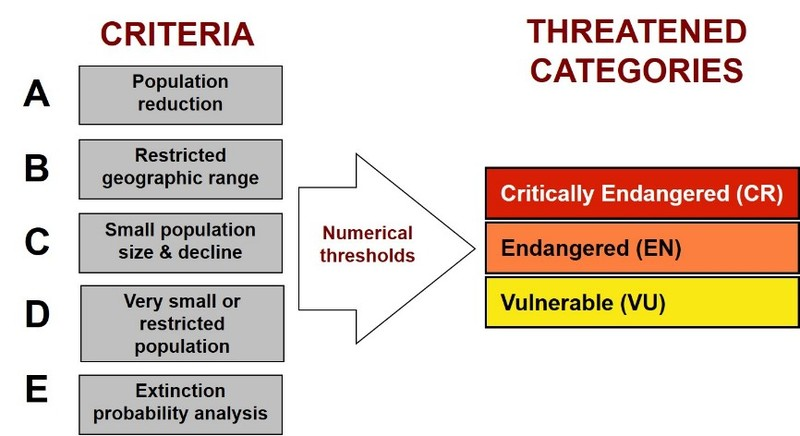 |
| The IUCN Red List Criteria |
Data for individual criteria are distinguished by color: Critically Endangered / Endangered / Vulnerable
A: Decrease in population size
- The rate of historical population reduction is ≥ 90% / ≥ 70% / ≥ 50% over the last 10 years or 3 generations (whichever is longer). The causes of the reduction are easily reversible, they are known and have already passed.
- The rate of historical population reduction is ≥ 80% / ≥ 50% / ≥ 30% over the last 10 years or 3 generations (whichever is longer). The causes of the reduction may still be ongoing or unknown or may not be reversible.
- The rate of predicted population reduction over the next 10 years or 3 generations (maximum 100 years) is ≥ 80% / ≥ 50% / ≥ 30%.
- The rate of predicted population reduction over the next 10 years or 3 generations (maximum 100 years) is ≥ 80% / ≥ 50% / ≥ 30%, with the time range including historical data. The causes of the reduction may still persist or be unknown or may not be reversible.
B: Reduction of geographical spread (criterion B1 and/or B2 fulfilled)
- The reduction in the extent of the expansion area occurred on the area of < 100 km2 / < 5,000 km2 / < 20,000 km2.
- The area of occurrence is < 10 km2 / < 500 km2 / < 2,000 km2.
and at least 2 of the following 3 criteria are met at the same time:
-
highly fragmented occurrence or occurrence in a single location / ≤ 5 locations / ≤ 10 locations;
-
continued reduction (it is enough to fulfill one of the points i to v)
-
scope of the area,
-
areas of occurrence,
-
habitat area or quality,
-
number of subpopulation locations,
-
number of adults;
-
-
extreme fluctuations (it is enough to fulfill one of points i to iv)
-
scope of the area,
-
areas of occurrence,
-
number of sites or subpopulations,
-
number of adults.
-
C: The population size is ≤ 250 / ≤ 2,500 / ≤ 10,000 adults and either/or:
- Estimated decrease in the next 3 years or within one generation is at least 25% / 5 years or within two generations is at least 20% / 10 years or within three generations is at least 10%.
- There is an ongoing decline while one of the following criteria is met:
- Population structure (it is enough to fulfill one of points i to ii):
- each of the subpopulations has ≤ 50 / ≤ 250 / ≤ 1,000 individuals or
- a single subpopulation includes more than 90% / 95% / 100% of adults.
- There are extreme fluctuations in the number of adults.
- Population structure (it is enough to fulfill one of points i to ii):
D: Population size is ≤ 50 adults / ≤ 50 adults /
- < 1,000 adults;
- the area of occurrence is < 20 km2 or the number of locations is ≤ 5.
E: Probability of extinction
- The probability of extinction in the wild is ≥ 50% in the next 10 years or 3 generations / ≥ 20% in the next 20 years or 5 generations / ≥ 10% in the next 100 years.
Berne Conventions ETS 104
The Convention on the Conservation of European Wild Plants, Wild Animals and Natural Habitats was negotiated on 19 September 1979 and entered into force on 1 June 1982. The Convention currently has 51 contracting parties, including the EU and all its member states. The Secretariat is based in Strasbourg, France, at the headquarters of the Council of Europe.
The aim of the Convention is to protect wild plants and wild animals of pan-European importance as well as their natural habitats (biotopes), especially endangered species, migratory species and species whose protection requires cooperation at the pan-European level.
The Convention has 4 annexes:
- Strictly protected plant species
- Strictly protected animal species
- Protected animal species
- Prohibited means and methods of killing, trapping and other forms of exploitation
Berne Conventions (main document)
In the framework of this convention, invertebrates are included in Annex II or III, and accordingly these species will receive the appropriate pictogram in the lexicon:
| Strictly Protected Species |  |
| Protected Species |  |