
Morphs and forms
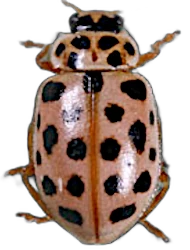
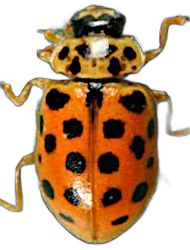
Compared with other species of the family Coccinellidae, Anisosticta novemdecimpunctata exhibits a generally lower degree of phenotypic variability; consequently, we do not find dramatically different colour forms (such as melanistic morphological types) in this species. Nevertheless, seasonal morphological changes in the basic colouration and variations in the extent and blending of the spots can be distinguished in this species.
Seasonal colour forms (seasonal chromotropism)
- Light / winter form (f. typica / autumn–winter form)
Adults that emerge in summer and overwintering individuals have a basic colouration of the elytra and scutellum ranging from beige and ivory to pale yellow-brown, which provides them with ideal camouflage in dry reeds and grasses. - Spring / red form (sexually mature female)
In the spring months, with the onset of reproductive activity, the colour darkens and the pigmentation changes; the elytra take on a deep pink, orange to red hue.
Morphs based on pattern and blending of spots (aberrant forms)
- Typical pattern (f. typica): Characterised by 19 separate black spots on the elytra and 6 on the scutellum.
- Flattened/fused morphs (f. confluens / f. fuszsteri): Small black spots touch one another or merge longitudinally or transversely into larger spotted bands (particularly on the pronotum or in the central part of the elytra).
- Reduced morphs (f. immaculata / f. paucipunctata): Rarer variants in which the number of spots is reduced (below the usual 15–19) or the spots are significantly smaller, to the point of being almost imperceptible.
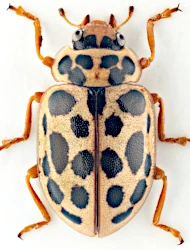
© Arnstein Staverløkk
01
01
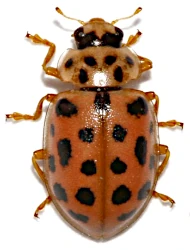
© Christian Goyaud
02
02
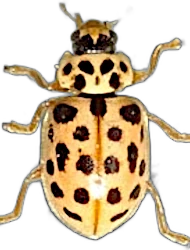
© Silke Lucke
03
03
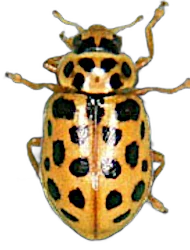
© Christoph Benisch
04
04
© Ingrid Altmann
05
05
© Ingrid Altmann
06
06
Sources
- Benisch, C. (2023): kerbtier.de – Beetle Fauna of Germany. – https://www.kerbtier.de/enindex.html (24.10.2026)
- Ivo Hodek, H. F. van Emden, Alois Honěk: Ecology and behaviour of the ladybird beetles (Coccinellidae), John Wiley & Sons, Ltd, 2012, ISBN: 978-1-4051-8422-9
- https://artsdatabanken.no/arter/takson/7387
- https://naturalistes-vendeens.org/faune/coccinelles/anisosticta_novemdecimpunctata/
