
Morphs and forms
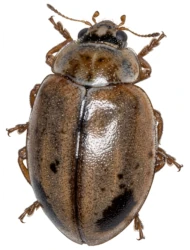
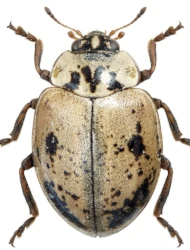
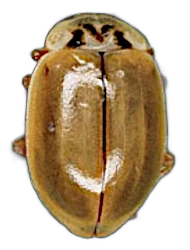
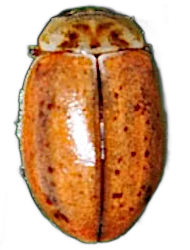
Aphidecta obliterata exhibits marked colour variability and polymorphism, which is particularly evident in females (sex-linked colour polymorphism). Furthermore, the species is strikingly sexually dimorphic in size — females are, on average, longer and wider than males. It has also been found that melanistic (dark) individuals survive overwintering better, so the proportion of dark forms increases in spring. Perhaps the best-known description of the individual forms and morphs in this species was provided by Eichhorn and Graf, who classified the individual morphs according to the following scheme:

- non-melanic (light-coloured) morphs
- Form I (Figs. 3–5)
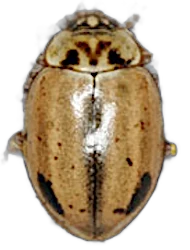
Usually referred to as the 'typica' form. Light brown, straw-yellow to ochre elytra, which may be unmarked or bear only very faint, blurred darker smudges or longitudinal stripes (often along the elytral suture). The pronotum has a characteristic dark marking in the shape of the letter ‘M’ or ‘W’. This form is typical of males, who occur in this form in approximately 99.7 per cent of cases. In contrast, females occur in this form in only approximately 0.9 per cent of cases. - Form II (Figs. 1, 6, 7)
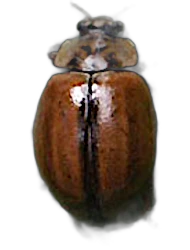
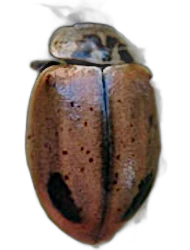
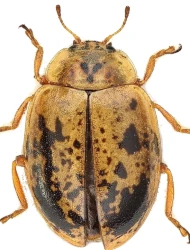
Usually referred to as the ‘livida’ form. A darker-spotted variant in which more distinct dark longitudinal stripes and a dark seam appear on the light-coloured elytra, particularly in the posterior half. The pronotum has a characteristic dark marking in the shape of the letter ‘M’ or ‘W’. Males of this form account for approximately 0.3 per cent of cases. Females of this form account for approximately 78.3 per cent of cases. - Form III (Figs. 2, 8, 12)
Usually referred to as the 'sexnotata' form. Similar to variant II, but with more distinct dark longitudinal stripes on the light-coloured elytra, a dark suture and other merging spots, particularly in the posterior half of the elytra. Males do not occur in this form. Females of this form occur in approximately 3.8 per cent of cases.
- Form I (Figs. 3–5)
- Melanic (dark) morphs
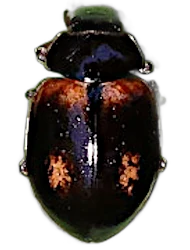
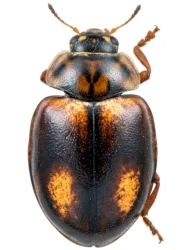
- Form IV (Figs. 9, 10, 13, 14)
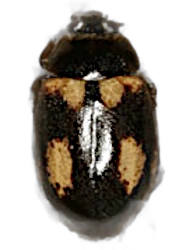
Usually referred to as the ‘fenestrata’ form. A significantly darker variant, in which black or dark brown predominates. The elytra are predominantly black with lighter (ochre or reddish) spots or marginal bands, forming a sort of ‘window-like’ pattern. Males do not occur in this form. Females of this form account for approximately 10.0 per cent of cases. - Form V (Fig. 11)
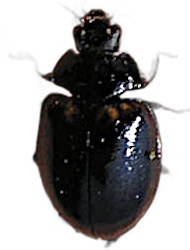
Usually referred to as the 'nigra' form. An almost entirely black form. Both the elytra and the scutellum are predominantly dark brown to black, with only minimal lighter markings on the margins of the scutellum or the shoulders of the elytra. Males do not occur in this form. Females of this form occur in approximately 7.0 per cent of cases.
- Form IV (Figs. 9, 10, 13, 14)
© Oldřich Nedvěd
01
01
© Oldřich Nedvěd
02
02
© Ingrid Altmann
03
03
© René Köhler
04
04
© Christoph Benisch
05
05
© Christoph Benisch
06
06
© Hedy Jansen
07
07

© Ingrid Altmann
08
08
© Christoph Benisch
09
09
© Peter Holzberger
10
10
© Arp Kruithof
11
11
© Stanislav Krejčík
12
12
© Jakub Široký
13
13
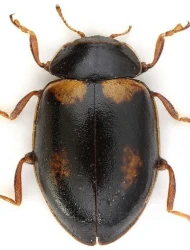
© Stanislav Krejčík
14
14
Sources
- Benisch, C. (2023): kerbtier.de – Beetle Fauna of Germany. – https://www.kerbtier.de/enindex.html (08.11.2026)
- Ivo Hodek, H. F. van Emden, Alois Honěk: Ecology and behaviour of the ladybird beetles (Coccinellidae), John Wiley & Sons, Ltd, 2012, ISBN: 978-1-4051-8422-9
- Biological Library; https://www.biolib.cz/
- Oldřich Nedvěd: Ladybird beetles (Coccinellidae) of Central Europe, Academia, Praha 2020, ISBN: 978-80-200-3023-8
- O. Eichhorn, P. Graf: Sex-linked Colour Polymorphism in Aphidecta obliterata L. (Coleoptera: Coccinellidae), Zeitschrift für Angewandte Entomologie, Volume67, Issue1-4, January/December 1971, Pages 225-231
