
Morphs and forms
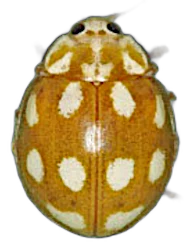
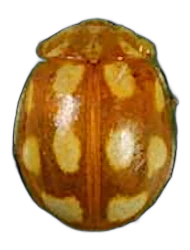
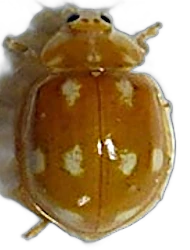
Calvia decemguttata exhibits relatively limited colour variation. The typical (nominotypical) form has elytra ranging from pale orange-brown to yellow-brown, with five large, often softly defined creamy-white spots on each elytron (arranged approximately 2-2-1, 10 spots in total). The pronotum is similarly coloured, with paler lateral margins or spots. However, certain variations in shape and colour do occur within populations, and the following basic forms are described in historical entomological literature:
- Typical form (Calvia decemguttata f. typica) (Figs. 1, 4–7)
The basic body colour is light brown, reddish to light yellowish-brown. On each elytron there are exactly 5 distinct, isolated round to oval white or cream-coloured spots. - Unicolor form/aberration (C. decemguttata ab. unicolor) (Fig. 3)
An extreme reductive form in which the white spots almost or completely disappear, so that the elytra have a uniform light brown-orange colouration without any distinctive markings - Hololeuca form (C. decemguttata var./ab. hololeuca) (Fig. 2)
A form characterised by a marked spreading and blending of the white pigment, whereby the white spots merge with the outline of the elytra or form larger light-coloured areas (so-called ‘hypochromatism’).
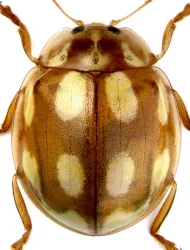
© K.V. Makarov
01
01
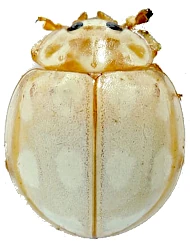
© A.G. Ponomarev
02
02
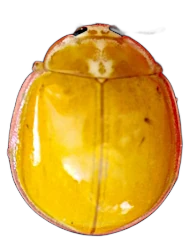
© Stanislav Krejčík
03
03
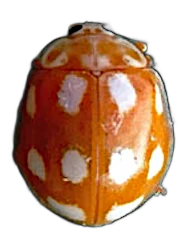
© C. Schmitt-Riegraf
04
04
© Christoph Benisch
05
05
© Ingrid Altmann
06
06
© Tilmann Adler
07
07
Sources
- Benisch, C. (2023): kerbtier.de – Beetle Fauna of Germany. – https://www.kerbtier.de/enindex.html (24.10.2026)
- Ivo Hodek, H. F. van Emden, Alois Honěk: Ecology and behaviour of the ladybird beetles (Coccinellidae), John Wiley & Sons, Ltd, 2012, ISBN: 978-1-4051-8422-9
- Biological Library; https://www.biolib.cz/
- Атлас жуков России и близлежащих стран: https://www.zin.ru/Animalia/Coleoptera/rus/atlas.htm
