
Morphs and forms
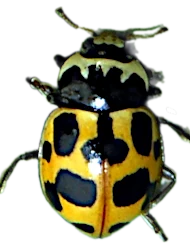
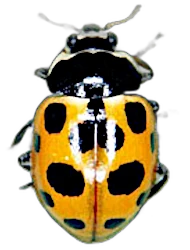
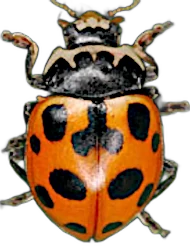
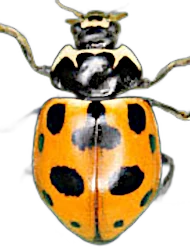
Ceratomegilla notata exhibits considerable variation in the colouration and pattern of its elytra. The elytra may range from yellow-orange to red and bear large black spots, whilst the scutellum is predominantly black with a white margin along the anterior edge. Historically, the following forms in particular have been described:
- Typical form (f. typica)
The elytra are yellow-brown, orange to brick-red with 13 well-defined black spots in a characteristic arrangement (1 on the scutellum and 6 on each elytron) - Form elongata
It has a more elongated body shape. All spots are large, with spots 3 and 4 fused. - Form quinquesignata
It exhibits a significant reduction in markings, with some of the lateral and posterior spots disappearing entirely, leaving only the nuchal spot and two to four dominant central spots. - C-nigrum form
In this form, the markings on the elytra merge to form a larger black pattern resembling the letter C.
© Algirdas
01
01
© Christoph Benisch
02
02
© Ingrid Altmann
03
03
© Christoph Benisch
04
04
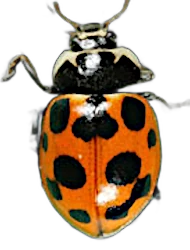
© Ingrid Altmann
05
05
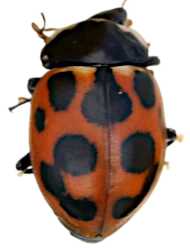
© Renko Usami
06
06
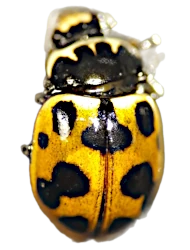
© anonymous
07
07
Sources
- Benisch, C. (2023): kerbtier.de – Beetle Fauna of Germany. – https://www.kerbtier.de/enindex.html (24.10.2026)
- Ivo Hodek, H. F. van Emden, Alois Honěk: Ecology and behaviour of the ladybird beetles (Coccinellidae), John Wiley & Sons, Ltd, 2012, ISBN: 978-1-4051-8422-9
- Wikipedia: https://en.wikipedia.org/wiki/Calvia_quatuordecimguttata
- https://www.galerie-insecte.org/galerie/Ceratomegilla_notata.html
