
Coleoptera > Polyphaga > Clambiformia > Clamboidea > Eucinetidae
- LAT: Cryptomeridae (Broun, 1893)
- LAT: Eucinétides (Lacordaire, 1857)
- CZ: no Czech name
- SK: no Slovak name
- PL: has no Polish name
- AT/DE/CH: Purzelkäfer
- HU: no Hungarian name
- EN: Eucinetid Beetles
- RU: Эуцинетиды (eucinetidy)
The name of the family Eucinetidae is derived from the name of the type genus Eucinetus, which was described by the German entomologist Ernst Friedrich Germar in 1818. The genus name Eucinetus originated in Greek:
- eu- (Greek εὖ) means good, true, right,
- kinetos (Greek κίνητος) means moving, mobile.
A literal translation could be "moving well" or "truly moving". This name probably refers to the typical evasive reaction that these beetles exhibit. In German, they are called "Purzelkäfer" (translated as "sweepers") precisely because they make rapid, "purzelnde" (sweeping, jumping) movements to escape when threatened.
History
The family Eucinetidae was described by the French entomologist Jean Théodore Lacordaire in 1857. Throughout the historical development of beetle classification, this group has been subject to shifts and redefinitions. It was originally placed in the now disused series Dascilliformia (Crowson, 1955), which was later redefined. Crowson (1960) removed the group Eucinetoidea (now Scirtoidea) from Dascilliformia and moved it to the new series Elateriformia.
Modern concepts of phylogeny (e.g., Crowson's work) have confirmed the close relationship of the family Eucinetidae to the families Clambidae and Scirtidae, with which it often forms the superfamily Scirtoidea (sometimes with the older name Eucinetoidea). However, Eucinetidae has generally been viewed as a separate family since its description and has not been widely classified as a subfamily of another family.
It is currently (according to the work of Bouchard, 2024 - Patrice Bouchard, Yves Bousquet, Anthony E. Davies, Chenyang Cai, On the nomenclatural status of type genera in Coleoptera (Insecta). ZooKeys 1194: 1-981 (2024), Published: 13 March 2024) The family Eucinetidae is arranged together with Clambidae, Derodontidae and Mesocinetidae within the superfamily Clamboidea.
The family has a long evolutionary history, as evidenced by the fossil genera found (e.g. from Cretaceous amber).
Morphology
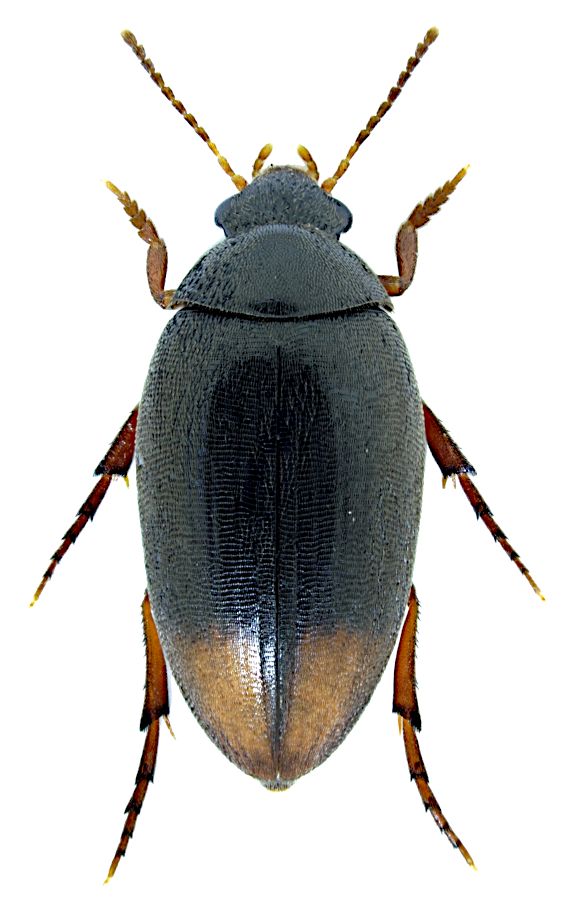
Eucinetidae are relatively small beetles. Their body length typically ranges from 0.8 mm to 4.0 mm. Adults (imago) have a very characteristic elliptical or ovoid and strongly arched (convex) body shape, which at first sight resembles a seed. The body is usually black or brown and often finely hairy. The head is small and strongly bent downwards and backwards, often hidden under the shield, contributing to the overall compact, ovoid shape. A distinctive morphological characteristic is the large coxal plates, which cover a significant part of the first ventrite of the abdomen (first segment of the ventral side). The tarsal pattern is 5-5-5 (five cells on all three pairs of legs) is an important diagnostic criterion. The antennae tend to be eleven-linked, long and filiform, sometimes with a slight thickening at the end. The shield is relatively large and broad.
In about half of the genera of Eucinetidae, the mouthparts (especially the anterior portion such as the labrum) are modified for suction feeding - that is, the beetles can suck in fluids (nutrients).
Bionomy
Eucinetidae are globally distributed (cosmopolitan) but are found primarily in forest habitats, both deciduous and coniferous or mixed. They prefer sites with rich and moist soil and leaf litter (detritus) or decaying organic matter. Larvae and adults are strongly associated with fungus-rich habitats (they are mycophagous). They can typically be found:
- In soil burrows and decaying leaves,
- Under the peeling bark of dead or fallen trees, especially where the bark is covered with fungi,
- In old decaying fungi and wood.
Adults feed on various species of fungi or fungal spores. In genera with modified mouthparts (sucking organs), adaptation for sucking nutrients from fungi (or perhaps fungal spores) is considered an evolutionary specialization. Beetles are often active at night and hidden in their habitat during the day.
The larvae also live in and feed on substrates rich in fungi, especially various fungi and their spores that grow in detritus or under bark. Their development is relatively poorly studied, but the link to fungi is central.
Indicative numbers of representatives of selected taxonomic units in individual regions
| Taxonomic Unit |
Region | |||||||||
| Czech republic |
Central Europe |
Europe | Afrotropical | Australian | Nearctic | Neotropical | Oriental | Palaearctic | World | |
| Subfamily | 0 | 0 | 0 | 0 | 0 | 0 | 0 | 0 | 0 | 0 |
| Tribe | 0 | 0 | 0 | 0 | 0 | 0 | 0 | 0 | 0 | 0 |
| Genus | 1 | 2 | 5 | 2 | 2 | 4 | 4 | 3 | 7 | 12 |
| Species | 1 | 2 | 8 | 5 | 18 | 10 | 10 | 9 | 9 | 53 |
Biggest and smallest
There is not extreme variability in size within the family, but the larger species reach a size of about 4 mm. For example, Eucinetus meridionalis reaches 3-4 mm or the genus Euscaphurus (Casey, 1885) includes species with more robust bodies.
In contrast, the smallest species of the family are close to the lower limit of 0.8 mm in size. An example is the genus Tohlezkus, which includes very small species (around 1 mm).
The rarest
In the Czech Republic, representatives of the family Eucinetidae are generally considered rare or locally occurring with very low abundance.
Because of their hidden way of life and small size, it is difficult to determine the exact degree of their rarity, but they are generally faunistically interesting species.
Globally, genera such as Jentozkus and Tohlezkus, described by Stanislav Vít, a Swiss entomologist of Czech origin working in Geneva, are worth mentioning. These genera are known only from limited localities (e.g. caves in the Canary Islands in the case of Jentozkus) and represent endemics or rare, specialised groups.
Attractions
- Suction tract: The presence of heavily modified mouthparts in some genera is curious and evolutionarily significant - showing adaptation to highly specialized feeding habitats (sponges).
- Paleontological history: fossil genera (e.g. Cretohlezkus in amber) show that the suctorial (sucking) mouthparts may have been present as early as the Mesozoic.
- Endemic and cavernicolous genera: The aforementioned genera Jentozkus and Tohlezkus are examples of how specialization in specific, isolated habitats (such as caves) can lead to unique and geographically restricted species (endemism). Their names are a tribute to the entomologist Vito (Jentozkus is derived from the name of Vito's wife Jarmila and Tohlezkus is a pun).
- Quick movements: the typical escape manoeuvre of performing quick "somersaults" is an interesting ethological feature behind the German name "Purzelkäfer".
Examples of global representatives of the family
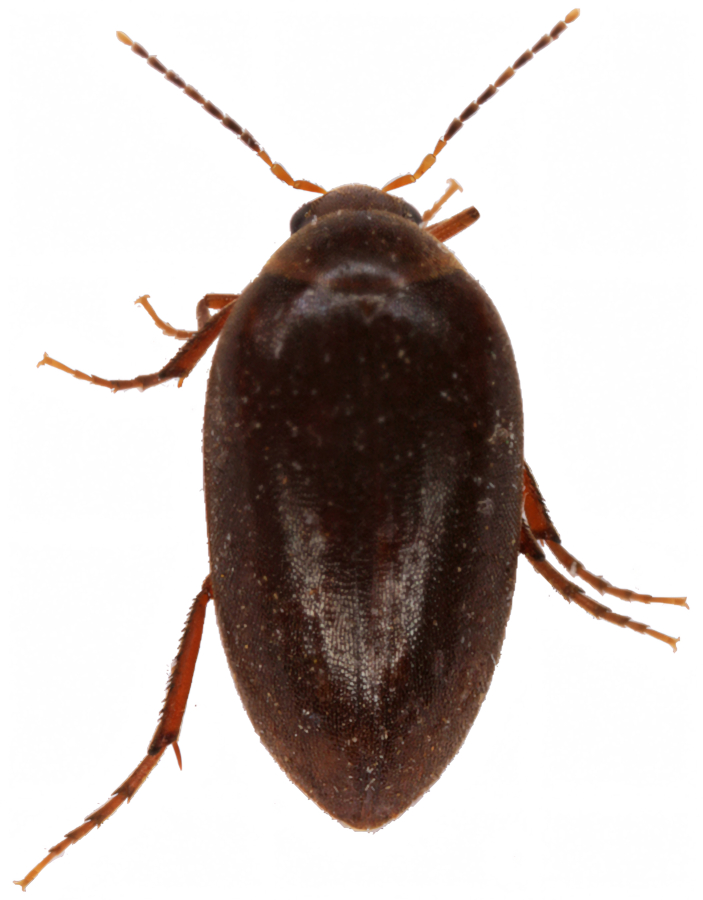

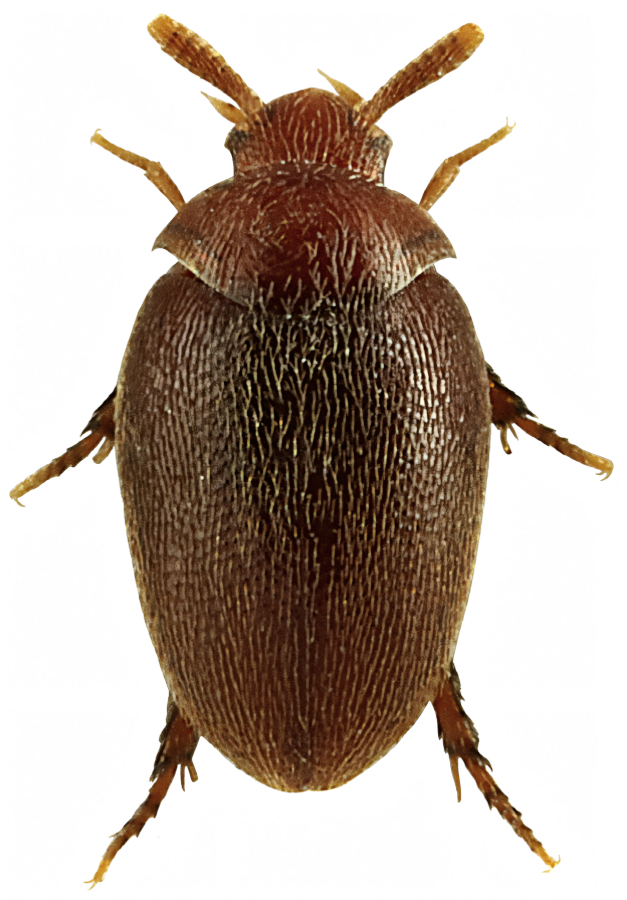
Examples of Czech representatives of the family

- Beutel R., Leschen R.: Handbook of Zoology, Arthropoda: Insecta, Coleoptera: Beetles, Ed. 2, Volume 1: Morphology and Systematics (Archostemata, Adephaga, Myxophaga, Polyphaga partim), Walter de Gruyter GmbH, Berlin/Boston, 2016
- Bouchard P.: The Book of Beetles, A Lifesize Guide to Six Hundred of Nature’s GEMS, Ivy Press, East Sussex, 2014
- Dlouhý F.: Brouci, Soustavný popis nejdůležitějších českých brouků s návodem, kterak zakládati sbírky broukův. 2. vydání, Nakladatel I. L. Kober, Praha, 1912
- Hůrka K.: Brouci České a Slovenské republiky, -, Nakladatelství Kabourek, Zlín, 2017
- Klapálek F.: Atlas brouků středoevropských, část 1, Nakladatel I. L. Kober, Praha, 1903
- Kliment J.: Čeští brouci, Dílo o broucích Čech, Moravy a Slezka, Vydal autor, 1899
- Miłkowski M.: Nowe stanowiska Eucinetus haemorrhoidalis (GERMAR, 1818) (Coleoptera: Eucinetidae) w okolicach Radomia, Wiadomości Entomologiczne, Vol. 39 (1); online 3N, 5–6, (2020), Poznań: 11 luty 2020, 2020
- Szalóki D., Tallósi B.: New records of two beetle species in Hungary (Coleoptera: Silvanidae, Eucinetidae), Folia Entomologica Hungarica, (2022), Volume 83, pp. 109−114, 22 November 2022, 2022
