Trypocopris (Trypocopris) vernalis vernalis (Linnaeus, 1758)
 Family: Geotrupidae
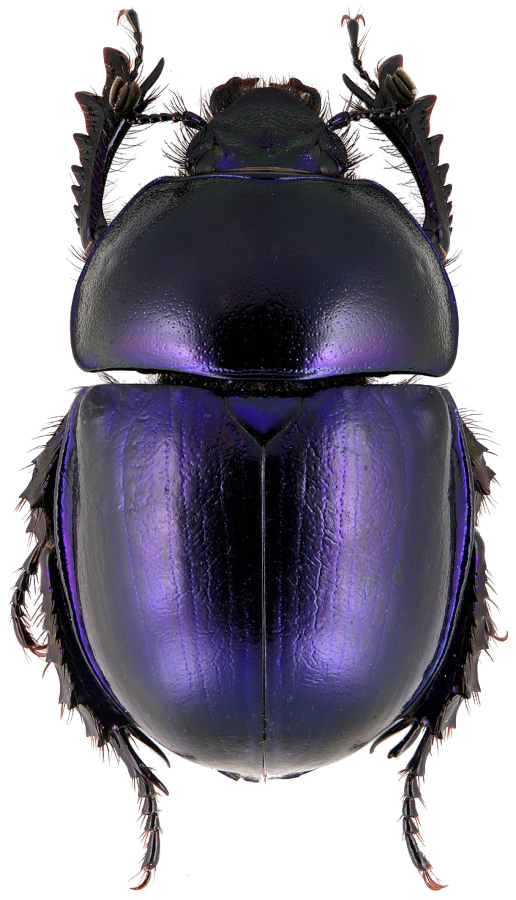
The adult beetle grows to a length of 12 - 20 mm. The colouration is highly variable, but it is typically a metallic shiny beetle. It may be coloured blue-green, blue-violet, or black-blue, less commonly pure black. The lower part of the body is often metallic blue. The body is oval, relatively robust and strongly arched. The pronotum has a relatively large number of pits, The elytra are smooth or with very faint punctate grooves. The head is broad, with prominent compound eyes and short, lamellate antennae. The antennae are brown, with a club-shaped end consisting of three lamellae. The legs are strong and short. The fore tibiae are extended and adapted for burrowing in the soil and handling food.
The activity of this species begins in early spring. The beetles usually appear from March/April and are active until mid-October. Maximum abundance is often observed in April and May. During warm spring days they can be seen flying low to the ground, often accompanied by a characteristic loud buzzing sound. It prefers open to semi-shaded sites such as pastures, forest edges, young pine stands, clearings, forest/field interstices and landscape mosaics. Often occurs in habitats with ungulate presence (grasslands) or in marginal stands where manure or carcasses are available. Some studies show a preference for younger forest stands. It has a wide distribution in the Palaearctic region - it occurs throughout Europe, except in the northernmost parts, and extends into Asia Minor and Siberia. It is a common and abundant species in the Czech Republic.
The species belongs to coprophagous (feeding on droppings) or saprophagous (feeding on decaying organic matter) beetles, with an important ecological role. Their main food is the droppings of herbivorous mammals (cattle, deer, horses, etc.), which they bury. They also feed on decaying fungi (mycophagous food component) and rotting plant material. The larvae feed mainly on the food reserves that the adult beetles prepare for them in underground passages. This food is composed of droppings. Mating takes place in spring (April/May). The pair then excavate a vertical main tunnel underground (often under the droppings), which can be up to 50 cm deep. From the main passage they excavate side chambers which they fill with droppings. The droppings are compacted into characteristic clumps (sometimes called 'pears') and provide food for the larvae. The female then lays individual eggs in these food chambers. The larva hatches and feeds on the prepared supply. The larva is thick, white, with a brown head and a typically axis-shaped curve. The larva usually takes one year to develop. The larva pupates in late summer/early autumn. The adult beetles hatch in autumn but overwinter in a pupal chamber in the soil, only to emerge the following spring.
Picture Source: Bleich