
| Numbers of saproxylic beetle species estimated in some European countries |
||
| Cited authors | Country | Species |
| Marhoul (2008); Krása (2015) | CZ | 1,300 |
| Seibold et al. (2015) | DE | 1,400 |
| Alexandr (2002) | UK | 1,700 |
| Bouget et al. (2008) | FR | 3,000 |
Saproxylic beetles are fascinating organisms that help scientists better understand how forest ecosystems function. These beetles have evolved to live exclusively on dead wood, and their life cycle is closely linked to the various stages of wood decomposition - from freshly fallen branches to heavily decomposed trunks. Thanks to their specialisation, they utilise a wide range of wood microhabitats and at the same time promote the spread of fungi that decompose wood. In this way, saproxylic beetles help the circulation of nutrients in the forest, influence soil structure and promote the diversity of plant and animal communities.
Among saproxylic beetles, there are so-called forest relicts, which are species that are very sensitive to environmental changes and need old and stable forests with a high amount of large-sized dead wood. These species use a complex network of microhabitats, such as tree cavities, rotten parts of trunks, old stumps or fungal fruiting bodies on wood, which provide food and shelter. Such places are rare in modern managed forests, which leads to the endangerment of these species and underlines the importance of preserving natural stands and natural processes in the forest.
Regular monitoring of saproxylic beetles is important for assessing the condition of forest ecosystems and biodiversity. Monitoring can identify endangered species, identify gaps in the availability of suitable dead wood, and evaluate the effectiveness of protective measures. Data obtained from long-term observations help foresters and ecologists plan forest management in such a way as to maintain suitable conditions for the survival of specialised species and the preservation of natural ecological processes.
The following paragraphs explain the individual columns in the table below. The classification of individual taxa into families has been retained according to the original source.
Relict forest species
Relict forest species (categories 1 and 2) are defined as species that meet the following criteria in Central Europe.
- they are closely linked to the continuity of old stands and habitat traditions,
- they have high requirements for the quality and quantity of dead wood,
- current populations in cultivated forests in Central Europe are declining or becoming extinct.
Within this group, we distinguish between relict species of old-growth forests sensu stricto (= category 1) and sensu lato (= category 2). Category 1 species are now limited to a few remnants of natural forests and require additional conditions, resources and structures, such as extensive forest landscapes, rare wood-dwelling fungi, large-sized dead wood, high tree age, heliophilous conditions, long-term maintenance and late succession stages of dead wood in stands. Category 1 species are therefore extremely rare. Category 2 species meet the same defined criteria but may also occur in production forests if their specific habitat requirements are met.
IUCN Red List categories
The International Union for Conservation of Nature (IUCN) Red List of Threatened Species is also known as the IUCN Red List or Red Book.
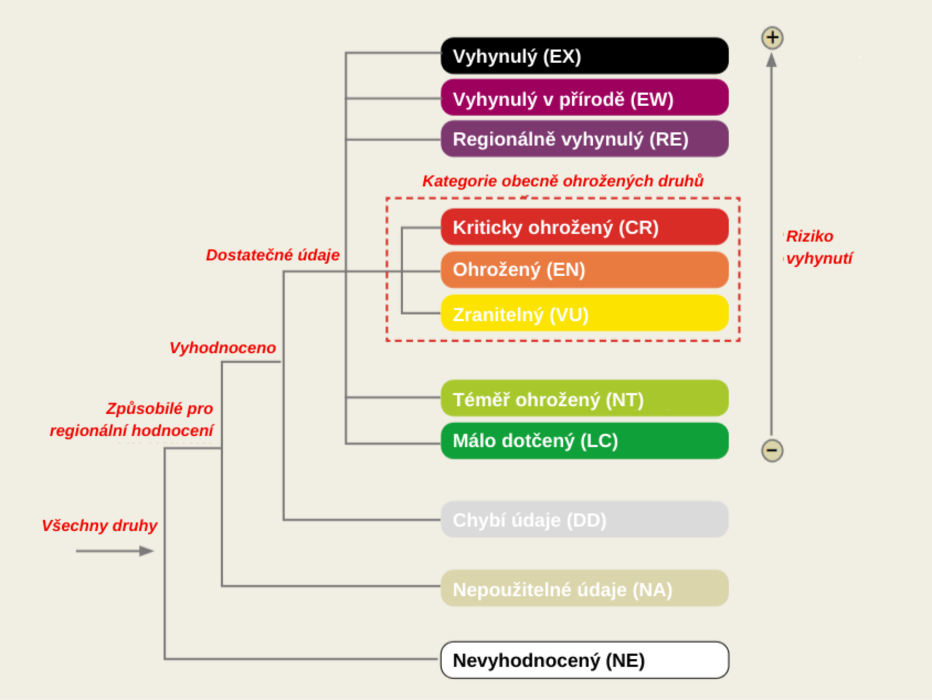
IUCN threat levels:
- Extinct (EX): there is no doubt that the species no longer exists. A species is classified in this category if no living representative has been found in the area for more than 50 years (but the species was previously known to occur there).
- Extinct in the wild (EW): the species survives only in captivity, cultivation and/or outside its original range, as assumed after exhaustive surveys. A species is classified in this category if no living representative has been found in the area for more than 50 years (but the species was previously known to occur there).
- Critically endangered (CR): species facing imminent extinction, surviving only in a few locations with a small number of individuals. The species meets any of the criteria A to E for critically endangered and is presumed to face an extremely high risk of extinction in the wild.
- Endangered (EN): a species that is relatively numerous but whose numbers have been declining recently. The species meets any of the criteria A to E for endangered and is considered to be facing a very high risk of extinction in the wild.
- Vulnerable (VU): a species facing an increased risk of extinction in the medium term if conditions do not change. The species meets any of the criteria A to E for vulnerable and is believed to face a high risk of extinction in the wild.
- Near Threatened (NT): A species that may be threatened with extinction in the near future but does not yet meet the criteria for Vulnerable, Endangered or Critically Endangered.
- Least Concern (LC): a species for which there is very little or no concern about its risk of extinction.
- Data Deficient (DD): a species is classified as "data deficient" if there is insufficient information available to make a direct or indirect assessment of its risk of extinction based on its distribution and/or population status.
Classification of substrate communities
- f - Fresh wood inhabitants
Fresh wood colonisers: vivixylophagous and zoophagous colonisers of living wood parts. Depending on the moisture content of the wood, colonisation of the substrate takes place up to approximately one year after the wood has died. - a - inhabitants of old wood
Old wood colonisers: saproxylic and zoophagous colonisers of wood that died a long time ago (old wood, decaying wood, wood humus). - m - inhabitants of mulm cavities
Colonisers of mulm cavities: xylodetritophages and zoophages colonising wood material decomposed into mulm inside still solid wood structures (mulm cavities, heart rot, etc. in broken and dead trees). - p - wood-decaying fungi
Wood fungus colonisers: mycetophagous colonisers of mouldy parts of wood or exclusively on fruiting bodies of fungi growing on wood. - s - xylophagous special biological systems
Xylobiont specialised organisms: succulent, necrophagous, coprophagous, saprophagous, nidicolous, pollenophagous, etc. Colonisers of wood structures (animals feeding on tree sap, commensals, parasites, animals feeding on chitin, carcasses and droppings in the nests and tunnels of other wood-destroying insects, etc.), colonisers of tree phytoteloms, etc.
Occurrence in the Czech Republic
Indicates whether the taxon occurs in the Czech Republic. The data corresponds to the status as of January 2026.
Sources
The table of primeval forest relics on this page is primarily based on the publication by A. Eclekt et al: "Primeval forest relict beetles" of Central Europe: a set of 168 umbrella species for the protection of primeval forest remnants, Journal of Insect Conservation, 2017. Data from the original table has been supplemented with data from other sources:
- European Red List of Saproxylic Beetles 2018
- European IUCN Red List (January 2025)
- J. Schmidl: Ökologische Gilden xylobionter Käfer Deutschlands, Naturschutz und Landschaftsplanung 36, (7), 2004.
- Zumr V., Remeš J.:Saproxyličtí brouci jako indikátor biodiverzity lesů a vliv lesnického managementu na jejich rozhodující životní atributy: review, 2020
| Selected important saproxylic beetles in Central Europe | |||||
| Family / Taxon | Reliquial forest species | IUCN Red List category (Europe) | Substrate communities | CZ | |
Boridae |
|||||
| Boros schneideri | 1 | NT | - | • | |
Bostrichidae |
|||||
| Lichenophanes varius | 2 | LC | a | • | |
| Stephanopachys linearis | 2 | LC | - | • | |
| Stephanopachys substriatus | 2 | LC | f | • | |
Bothrideridae |
|||||
| Oxylaemus variolosus | 2 | - | a | - | |
| Teredus cylindricus | 2 | - | a | - | |
| Teredus opacus | 1 | - | - | - | |
Buprestidae |
|||||
| Acmaeodera degener | 1 | - | f | • | |
| Buprestis splendens | 1 | EN | f | • | |
| Dicerca aenea | 2 | - | f | • | |
| Dicerca alni | 2 | - | f | • | |
| Dicerca berolinensis | 2 | - | f | • | |
| Dicerca furcata | 1 | - | f | • | |
| Dicerca moesta | 2 | - | f | • | |
| Eurythyrea austriaca | 1 | - | f | • | |
| Eurythyrea quercus | 1 | - | f | • | |
Cerambycidae |
|||||
| Aegosoma scabricorne | 2 | LC | a | • | |
| Akimerus schaefferi | 2 | EN | a | • | |
| Alosterna ingrica | 2 | LC | - | - | |
| Cerambyx cerdo | 2 | NT | f | • | |
| Cornumutila lineata | 2 | EN | - | • | |
| Evodinus borealis | 1 | LC | - | - | |
| Macroleptura thoracica | 1 | NT | - | - | |
| Necydalis ulmi | 2 | VU | a | • | |
| Nivellia sanguinosa | 2 | EN | a | • | |
| Nothorhina muricata | 2 | VU | f | - | |
| Rosalia alpina | 2 | NT | a | • | |
| Saperda punctata | 2 | NT | f | • | |
| Stictoleptura erythroptera | 1 | VU | a | • | |
| Stictoleptura variicornis | 2 | LC | - | - | |
| Tragosoma depsarium | 2 | VU | a | • | |
Cerophytidae |
|||||
| Cerophytum elateroides | 2 | NT | a | • | |
Cerylonidae |
|||||
| Philothermus evanescens | 2 | - | a | • | |
Ciidae |
|||||
| Dolichocis laricinus | 1 | - | p | - | |
| Ennearthron palmi | 2 | - | p | • | |
Cleridae |
|||||
| Dermestoides sanguinicollis | 2 | - | a | • | |
Cryptophagidae |
|||||
| Cryptophagus confusus | 2 | - | m | • | |
| Cryptophagus lysholmi | 2 | - | p | • | |
| Cryptophagus quercinus | 2 | - | m | • | |
Cucujidae |
|||||
| Cucujus haematodes | 1 | EN | - | • | |
Curculionidae |
|||||
| Camptorhinus statua | 1 | - | f | • | |
| Euryommatus mariae | 2 | - | - | - | |
| Gasterocercus depressirostris | 2 | - | f | • | |
| Hexarthrum duplicatum | 2 | - | a | • | |
| Rhyncolus reflexus | 2 | - | a | • | |
Derodontidae |
|||||
| Derodontus macularis | 2 | - | p | • | |
Elateridae |
|||||
| Ampedus auripes | 2 | LC | a | • | |
| Ampedus brunnicornis | 1 | VU | m | • | |
| Ampedus cardinalis | 1 | NT | m | • | |
| Ampedus elegantulus | 2 | NT | a | • | |
| Ampedus melanurus | 2 | NT | a | • | |
| Ampedus quadrisignatus | 1 | EN | - | • | |
| Ampedus suecicus | 1 | - | - | • | |
| Ampedus tristis | 2 | LC | a | • | |
| Brachygonus ruficeps | 1 | VU | m | • | |
| Cardiophorus gramineus | 2 | NT | a | • | |
| Crepidophorus mutilatus | 2 | VU | m | • | |
| Danosoma conspersum | 1 | LC | - | - | |
| Denticollis borealis | 1 | LC | a | • | |
| Elater ferrugineus | 2 | NT | m | • | |
| Ischnodes sanguinicollis | 2 | VU | m | • | |
| Lacon lepidopterus | 1 | EN | a | • | |
| Lacon punctatus | 2 | LC | a | • | |
| Lacon querceus | 1 | VU | m | • | |
| Limoniscus violaceus | 1 | EN | m | • | |
| Megapenthes lugens | 2 | VU | m | • | |
| Podeonius acuticornis | 1 | EN | m | • | |
| Reitter's sandpiper dubius | 1 | EN | m | • | |
Endecatomidae |
|||||
| Endecatomus reticulatus | 1 | - | - | • | |
Endomychidae |
|||||
| Leiestes seminiger | 2 | - | p | • | |
| Pleganophorus bispinosus | 1 | - | - | • | |
Erotylidae |
|||||
| Dacne notata | 1 | NT | p | • | |
| Dacne pontica | 2 | LC | - | - | |
| Triplax collaris | 2 | LC | p | • | |
| Triplax elongata | 1 | VU | p | • | |
| Triplax melanocephala | 1 | LC | p | - | |
| Tritoma subbasalis | 2 | LC | p | - | |
Eucnemidae |
|||||
| Dirrhagofarsus attenuatus | 1 | NT | - | • | |
| Farsus dubius | 1 | NT | - | • | |
| Microrhagus pyrenaeus | 2 | NT | a | • | |
| Nematodes phylum | 2 | LC | a | • | |
| Otho sphondyloides | 1 | NT | - | • | |
| Thambus friwaldszkyi | 1 | NT | - | - | |
| Xylophilus testaceus | 2 | NT | a | • | |
Histeridae |
|||||
| Abraeus parvulus | 2 | - | a | • | |
| Epierus comptus | 2 | - | a | • | |
| Platylomalus complanatus | 2 | - | a | • | |
| Platysoma deplanatum | 1 | - | a | • | |
Laemophloeidae |
|||||
| Cryptolestes abietis | 2 | - | f | - | |
| Laemophloeus muticus | 1 | - | f | - | |
Latridiidae |
|||||
| Corticaria interstitialis | 2 | - | - | • | |
| Corticaria lapponica | 2 | - | - | • | |
| Corticaria lateritia | 2 | - | a | • | |
| Corticaria orbicollis | 2 | - | - | - | |
| Latridius brevicollis | 2 | - | p | • | |
Leiodidae |
|||||
| Dreposcia umbrina | 1 | - | a | • | |
Lucanidae |
|||||
| Aesalus scarabaeoides | 2 | VU | a | • | |
| Ceruchus chrysomelinus | 2 | NT | a | • | |
Lycidae |
|||||
| Lopheros lineatus | 2 | - | - | - | |
Melandryidae |
|||||
| Dircaea australis | 2 | - | a | • | |
| Dircaea quadriguttata | 1 | - | - | - | |
| Mycetoma suturale | 2 | - | p | • | |
| Phryganophilus auritus | 1 | - | - | • | |
| Phryganophilus ruficollis | 1 | NT | a | • | |
| Rushia parreyssi | 2 | - | - | - | |
Mycetophagidae |
|||||
| Mycetophagus ater | 2 | LC | p | • | |
| Mycetophagus decempunctatus | 2 | LC | p | • | |
Oedemeridae |
|||||
| Ditylus laevis | 1 | LC | a | • | |
Prostomidae |
|||||
| Prostomis mandibularis | 2 | VU | a | • | |
Ptinidae |
|||||
| Anitys rubens | 2 | - | a | • | |
| Dorcatoma ambjoerni | 1 | - | - | • | |
| Ernobius explanatus | 2 | - | - | - | |
| Ernobius kiesenwetteri | 2 | - | a | • | |
| Ernobius laticollis | 2 | - | - | - | |
| Stagetus borealis | 2 | - | p | - | |
| Xestobium austriacum | 2 | - | a | • | |
Pyrochroidae |
|||||
| Agnathus decoratus | 2 | - | f | • | |
Pythidae |
|||||
| Pytho abieticola | 1 | VU | f | • | |
| Pytho kolwensis | 1 | VU | - | - | |
Rhizophagidae |
|||||
| Rhizophagus brancsiki | 2 | - | - | • | |
Rhysodidae |
|||||
| Omoglymmius germari | 1 | EN | - | • | |
| Rhysodes sulcatus | 1 | EN | - | • | |
Scarabaeidae |
|||||
| Gnorimus variabilis | 2 | NT | m | • | |
| Osmoderma eremita | 2 | NT | m | - | |
Staphylinidae |
|||||
| Abemus chloropterus | 2 | - | - | • | |
| Batrisodes hubenthali | 2 | - | - | • | |
| Bibloporus ultimus | 1 | - | a | • | |
| Bolitochara lucida | 2 | - | p | • | |
| Euryusa coarctata | 2 | - | s | • | |
| Gyrophaena nitidula | 2 | - | - | • | |
| Hesperus rufipennis | 2 | - | a | • | |
| Lordithon pulchellus | 2 | - | p | • | |
| Lordithon speciosus | 2 | - | p | • | |
| Olisthaerus substriatus | 2 | - | - | • | |
| Phymatura brevicollis | 2 | - | p | • | |
| Quedius infuscatus | 2 | - | m | • | |
| Quedius truncicola | 2 | - | m | • | |
| Sepedophilus binotatus | 2 | - | a | • | |
| Stenichnus foveola | 1 | - | a | • | |
| Tachyusida gracilis | 1 | - | a | • | |
| Thoracophorus corticinus | 2 | - | s | • | |
| Trigonurus mellyi | 2 | - | - | - | |
Tenebrionidae |
|||||
| Allecula rhenana | 2 | LC | m | • | |
| Thoracic artery | 1 | - | a | - | |
| Bolitophagus interruptus | 1 | - | p | • | |
| Corticeus bicoloroides | 2 | LC | a | • | |
| Corticeus fasciatus | 2 | NT | a | • | |
| Corticeus suturalis | 1 | NT | f | • | |
| Corticeus versipellis | 1 | EN | f | • | |
| Eledonoprius armatus | 1 | - | p | • | |
| Hymenophorus doublieri | 1 | VU | - | • | |
| Mycetochara obscura | 2 | LC | - | • | |
| Mycetochara quadrimaculata | 2 | NT | - | • | |
| Neatus picipes | 2 | - | a | • | |
| Platydema dejeani | 2 | VU | p | • | |
| Prionychus melanarius | 2 | LC | m | • | |
| Tenebrio opacus | 1 | - | m | • | |
Trogositidae |
|||||
| Calitys scabra | 1 | VU | p | • | |
| Grynocharis oblonga | 2 | LC | p | • | |
| Peltis grossa | 1 | NT | p | • | |
| Temnochila caerulea | 2 | LC | a | • | |
Zopheridae |
|||||
| Colydium filiforme | 2 | - | a | • | |
| Endophloeus marcovichianus | 2 | LC | - | - | |
| Lasconotus jelskii | 1 | - | - | - | |
| Pycnomerus terebrans | 2 | - | a | • | |
| Rhopalocerus rondanii | 2 | - | a | • | |
| Synchita separanda | 2 | LC | a | • | |
| Xylolaemus fasciculosus | 1 | EN | - | - | |
